

Real-time CRM transforms how iGaming operators engage with players by delivering instant, personalized responses based on their actions. Instead of relying on delayed, generic campaigns, this approach uses in-game triggers to keep players engaged while they’re still active. Here’s how it works:
- Immediate Reactions: Players receive tailored offers, like a welcome bonus upon registration or a “bad-luck bonus” after a losing streak, in real time.
- Boosted Engagement: Trigger-based campaigns increase player retention and lifetime value (LTV) by up to 28%.
- Advanced Automation: Modern CRM platforms automate over 50 event triggers, ensuring timely, relevant interactions for all players.
- AI Integration: AI predicts player behavior, enabling proactive responses like churn prevention or tailored incentives.
This strategy is accessible even to small operators, thanks to affordable, iGaming-specific CRM platforms like InTarget. These tools simplify implementation, offering quick setup, no-code features, and AI-driven insights to maximize impact without requiring large teams or budgets.
Operators can start with high-impact triggers (e.g., welcome bonuses, re-engagement offers) and expand as they grow, ensuring efficient, real-time marketing tailored to every player.
What In-Game Triggers Are and How They Work in CRM
Defining In-Game Triggers
In-game triggers are specific actions taken by players that automatically prompt a marketing response through a CRM system. For instance, actions like placing a bet or experiencing a balance drop can activate tailored responses from the system.
But triggers can go much deeper than these basic actions. Imagine a player losing twice in a row on the same slot game – this could prompt the system to send a "bad-luck bonus" to soften the blow. Or consider a VIP player who returns after a three-month hiatus – they might receive a welcome-back offer, complete with free spins. Even browsing behavior can be a trigger. If a player checks out several blackjack tables but doesn’t place a bet, the system might step in with a gentle nudge to encourage them to play. In the world of sportsbooks, triggers get even more specific. For example, a player watching a live football match could receive a halftime offer for free blackjack rounds, tailored to their betting history and the game’s progression.
How CRM Systems Process In-Game Events in Real Time
Here’s how it works: first, the system detects player actions in real time. Then, it uses behavior-based micro-segmentation to identify which players qualify for specific offers. Finally, the system delivers notifications through various channels like pop-ups, push notifications, SMS, or email.
Some advanced systems take this a step further by using webhooks to instantly deliver personalized bonuses directly into a player’s account during their session. This creates a seamless experience that keeps players engaged. To fine-tune these efforts, operators often use test and control groups to measure the financial impact of different trigger-message combinations. This approach has proven to be a game-changer, with trigger-based marketing delivering a 14% boost in conversions compared to traditional batch campaigns that rely on generic, scheduled messages.
These real-time capabilities pave the way for some compelling examples of how triggers are applied in practice.
Real-Time Trigger Examples in Practice
Let’s break down a few scenarios where real-time triggers make a difference:
- Retention: A high roller who experiences a significant loss might automatically receive a percentage refund or a bad-luck bonus before they log off.
- Re-engagement: A player who has been inactive for months could return to a personalized welcome-back offer, designed with their past preferences in mind.
- Cross-Selling: A sports bettor watching a live match might get an offer for free blackjack rounds during halftime, encouraging them to explore other games.
- Monetization: If a player’s account balance drops below a certain threshold, they might instantly see a 100% deposit match offer pop up.
"The power of this personalized, realtime messaging is enormous. Instead of focusing marketing efforts only on ‘getting the customer into the store,’ the customer is already ‘in the store’ and the marketer has a very good idea of what the customer wants." – Pini Yakuel, CEO, Optimove
The real advantage lies in the timing. Instead of sending out a generic email days later, these systems respond instantly, while the player is still active. This turns moments of hesitation or frustration into opportunities to build stronger connections.
Why Player Segmentation Matters for Trigger Accuracy
Real-time triggers are only as effective as the precision with which they target players. Without proper segmentation, even the most advanced CRM systems can fall short – sending high-roller bonuses to casual players or slot promotions to users who only bet on sports. Segmentation organizes raw data into meaningful groups, ensuring that each trigger reaches the right audience. This precision is the backbone of any real-time CRM strategy, allowing operators to use in-game triggers to their fullest potential.
The difference between a generic campaign and an impactful one often lies in how well you understand and segment your audience. For instance, a player who lost $500 playing blackjack requires a very different follow-up than someone who lost $20 on slots. Similarly, a new user exploring your platform has different needs than a VIP who’s been active for years. The finer your segmentation, the more precise your triggers will be. This groundwork paves the way for detailed behavioral, demographic, and risk-based segmentation strategies.
Segmentation by Behavior and Demographics
Behavioral and demographic segmentation takes this concept a step further by tailoring messages to specific player actions and characteristics. Behavioral segmentation focuses on what players actually do – such as the games they play, how often they bet, their session times, deposit habits, and win/loss patterns. For example, a player who consistently bets on live sports in the evenings needs different messaging than someone who plays slots during their lunch break.
Demographic data adds another layer of refinement. Factors like age, location, preferred devices, and communication channels significantly influence how players engage with your platform. Younger users may respond more to mobile push notifications, while older players might prefer email. Some operators even segment by language and time zone to ensure messages are both timely and relevant. Combining behavioral insights with demographic data allows CRMs to deliver personalized experiences automatically, without requiring manual adjustments.
Segmentation for Risk and Compliance
Segmentation also plays a critical role in meeting regulatory standards and protecting players. Real-time compliance checks within CRM systems can instantly exclude ineligible players from campaigns. This ensures that trigger-based messages never reach individuals who shouldn’t receive them, safeguarding both the operator and the player.
Risk-based segmentation helps operators maintain a balance between offering promotions and managing profitability. Players who display unusual betting patterns, sudden deposit spikes, or signs of potential problem gambling can be moved into restricted segments immediately. This dynamic approach doesn’t just group players by value – it adjusts based on lifecycle and behavioral changes over time.
Additionally, iGaming CRMs maintain detailed audit trails, logging every action, from compliance checks to player consent. These records provide a clear, regulator-ready history, demonstrating that trigger-based campaigns prioritize both player safety and adherence to legal requirements.
How AI and Automation Improve Trigger-Based Campaigns
AI takes trigger-based campaigns to the next level by shifting from a reactive approach to a predictive one. Instead of waiting for signs of churn, AI models analyze patterns like betting behavior, session frequency, and deposit activity to spot potential risks ahead of time. These systems process live data in just 1.8 seconds [1], allowing them to respond while the player is still active. For example, during live sports events, if a player’s betting history shows a downturn, AI can instantly trigger an offer – like cashback or adjusted odds – delivered in real time. This combination of prediction and immediate action highlights AI’s ability to adapt campaigns dynamically.
Platforms like InTarget make this even easier by offering natural language AI assistants. Marketing teams can ask questions like, "Which players haven’t made a deposit in the last 10 days?" and get instant, visual reports – no SQL expertise or dedicated data analyst required. This eliminates bottlenecks, especially for smaller operators working with limited resources.
Automation complements AI by fine-tuning campaigns based on player responses. For instance, if a player opens a bonus email but doesn’t deposit, the system can automatically follow up with a stronger incentive via SMS within minutes. These automated re-engagement flows boost conversion rates by 14% [2]. Instead of just sending messages, these systems adjust the entire player journey in real time, reacting to each step the player takes.
AI-driven churn prediction is particularly impactful in the fast-moving iGaming industry, where player behavior can change quickly. Advanced CRMs can reduce churn by up to 20% [3] through timely actions like personalized bonuses, VIP upgrades, or check-in messages. The speed of these systems ensures that offers are delivered while players are still engaged.
These AI-powered tools don’t just streamline campaign execution – they also amplify the effectiveness of real-time CRM strategies for player retention. Unlike traditional CRMs that typically offer 5–10 triggers and take months to implement, AI-driven CRMs like InTarget provide over 50 advanced triggers in just one week. Plus, they’re more affordable, starting at $750 per month compared to $5,000+ for older systems [4]. This mix of speed, cost efficiency, and intelligence makes AI-driven automation a game-changer, even for smaller operators competing with industry giants.
How Small and Mid-Sized Operators Can Implement In-Game Triggers
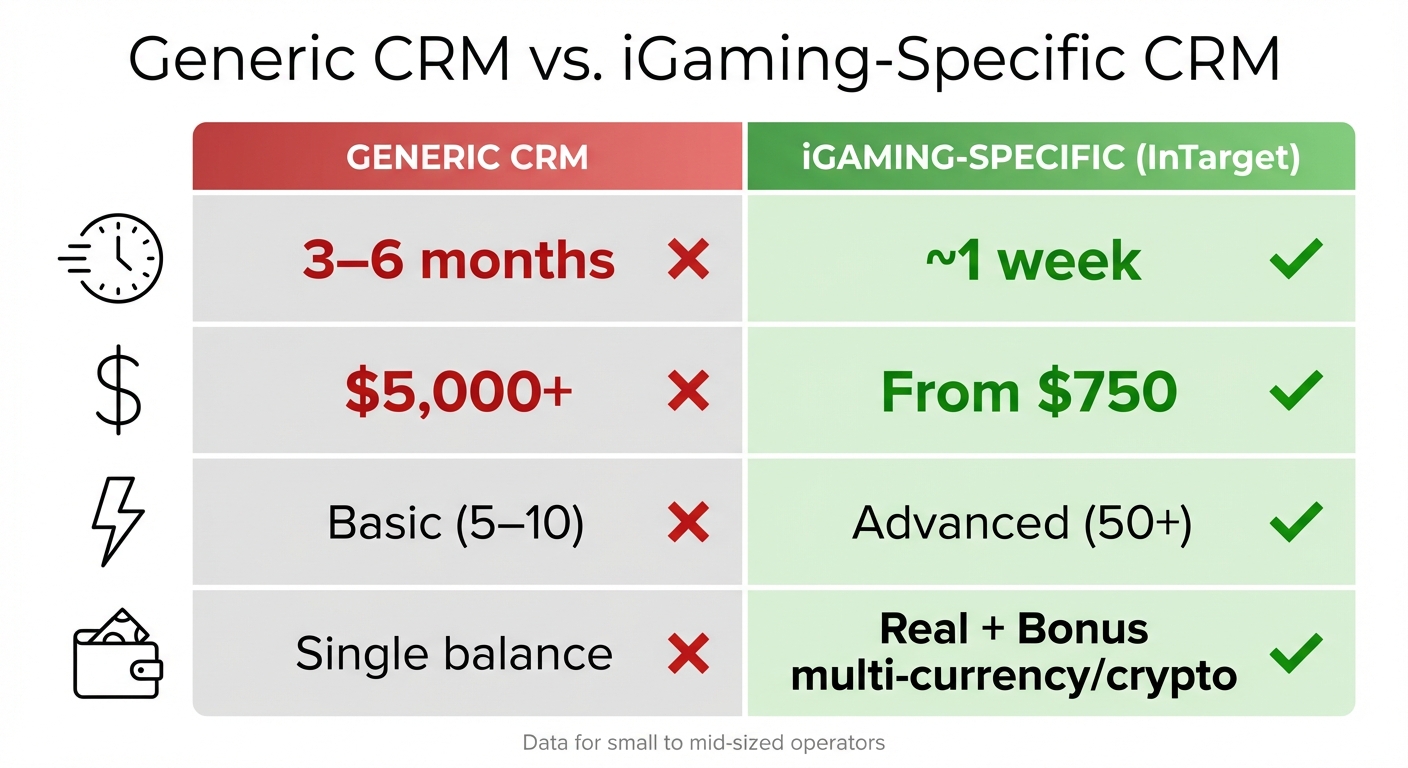
Generic CRM vs iGaming-Specific CRM Platform Comparison
Selecting a CRM Platform That Fits Your Needs
Generic CRM platforms often fall short when it comes to iGaming-specific requirements. They miss out on key metrics like Gross Gaming Revenue (GGR) and First Time Deposits (FTDs), and their setup can take 3–6 months while demanding expensive custom integrations. On the other hand, platforms designed specifically for iGaming, such as InTarget, can be up and running in about one week and start at just $750 per month, compared to the $5,000+ monthly cost of enterprise-level generic systems.
When choosing a platform, prioritize features like no-code visual builders and AI assistants that simplify data insights. For example, marketing teams can ask questions like, "What were the top 10 games by player count last week?" and receive instant, clear reports – no need for a dedicated data analyst. Additionally, a platform that provides a 360° player view – covering spins, wins, deposits, and communication logs – can bridge the gap between support and marketing, ensuring smoother operations.
Quick Comparison: Generic CRM vs. iGaming-Specific Solutions
| Feature | Generic CRM | iGaming-Specific (InTarget) |
|---|---|---|
| Setup Time | 3–6 months | ~1 week |
| Monthly Cost | $5,000+ | From $750 |
| Triggers Available | Basic (5–10) | Advanced (50+) |
| Wallet Tracking | Single balance | Real + Bonus multi-currency/crypto |
By selecting a specialized platform, operators can avoid unnecessary delays and expenses, making it easier to implement in-game triggers effectively.
Working with Limited Budgets and Small Teams
If your team is small and your budget limited, focus on high-impact triggers that deliver measurable results. Start with essential campaigns like welcome messages, re-engagement notifications, and loss alerts, which can quickly boost your return on investment. Roll out these triggers step by step – beginning with email and SMS before expanding to push notifications and webhooks as your team gains confidence and experience.
To maximize your budget, invest in tools that ensure your messages hit inboxes rather than spam folders. Platforms that include email deliverability tools, free data migration, and dedicated support managers can ease the transition process, allowing you to concentrate on campaigns rather than technical challenges. Additionally, AI-powered data cleaning tools can save hours of manual work by automatically merging duplicate profiles and verifying player information in real time.
Conclusion: Improving Retention with Real-Time CRM and In-Game Triggers
Real-time CRM systems have reshaped how iGaming operators approach player retention. Instead of relying on scheduled batch campaigns sent to broad audiences, these systems enable instant, trigger-based messaging tailored to specific player actions. Whether a player hits a loss limit, completes their first deposit, or goes inactive for a few days, timely and relevant engagement can make all the difference in preventing churn.
With advanced segmentation and automation, even smaller teams can compete with industry giants. By tracking every player interaction – from their first spin to their final withdrawal – CRMs empower marketers to respond immediately with offers tailored to individual behaviors. For instance, offering a loss refund to high rollers or a deposit match when a player’s balance dips below $100 can significantly boost engagement. Operators using specialized iGaming CRMs have reported an average 28% increase in Lifetime Value (LTV) after fully integrating these tools [1].
For small and mid-sized operators, ease of use matters just as much as functionality. Platforms like InTarget provide enterprise-level features at an accessible price – starting at $750 per month and ready to launch in just a week. Tools like AI Data Helpers make it easy for non-technical team members to query player data in plain language and receive instant insights, eliminating the need for a dedicated analytics team.
To get started, focus on high-impact triggers such as welcome messages, re-engagement campaigns, and loss alerts. As your team becomes more comfortable, expand to include advanced features like no-code builders, multi-currency wallet tracking, and an extensive range of triggers (50+ compared to the limited 5–10 in generic systems). With the right tools and strategies, implementing effective retention campaigns becomes not only achievable but efficient.
FAQs
How do in-game triggers improve player engagement in real-time CRM?
In-game triggers leverage players’ real-time actions – like logging in, choosing a game, or placing a bet – to instantly send tailored messages or offers. These timely and relevant interactions can increase player engagement by 10–15%.
By reacting to what players are doing in the moment, real-time CRM systems help ensure players feel recognized and appreciated. This not only strengthens their connection to the platform but also motivates them to stay active.
How does AI enhance trigger-based marketing in iGaming?
AI has become a game-changer for trigger-based marketing campaigns, helping them become sharper and more impactful. By analyzing player behavior in real time, it can automatically group users into segments, pinpoint ideal moments to send tailored offers, and fine-tune engagement strategies.
Thanks to AI, marketing teams can access immediate, data-backed insights to adjust their campaigns on the fly. This means players get messages that truly resonate, delivered at the perfect time, boosting both retention and overall satisfaction.
How can small iGaming operators use in-game triggers to boost player engagement with limited resources?
Small iGaming operators can successfully introduce in-game triggers by utilizing a lightweight, real-time CRM that combines automation, trigger logic, and analytics. The first step is to pinpoint key player behaviors, such as returning after a 48-hour absence, placing their first bet on a new sport, or abandoning the platform after a failed deposit. These behaviors can serve as simple triggers. Tools like InTarget make it easy to set up these triggers and connect them to personalized messages through email, SMS, or push notifications, potentially boosting engagement by 10–15%.
Stick to the core channels you already use and take advantage of built-in features like AI assistants to handle quick queries, such as identifying players who haven’t deposited in the last 10 days. This approach eliminates the need for a dedicated data analyst and keeps the process straightforward. Prebuilt templates and integrations allow you to send bonuses or free spins instantly, without requiring custom development. Over time, you can expand your strategy by introducing more advanced segmentation, such as VIP tiers or location-specific offers, to further enhance retention efforts.
To keep expenses under control, opt for a CRM with clear, budget-friendly pricing tailored to smaller operators. By starting with a few impactful triggers and leveraging ready-to-use automation, even iGaming brands with limited resources can deliver timely, personalized offers that strengthen player retention and increase lifetime value.