
Player activity tracking means recording what each player does (logins, deposits, game sessions, bets) and attaching it to one record, so that marketing reacts to behavior instead of sending the same promotion to everyone. The same data serves fraud checks, compliance and responsible gaming. This article covers which metrics to watch, where the data comes from, what a CRM such as InTarget records and what it leaves to other tools, and how to use the data for retention.
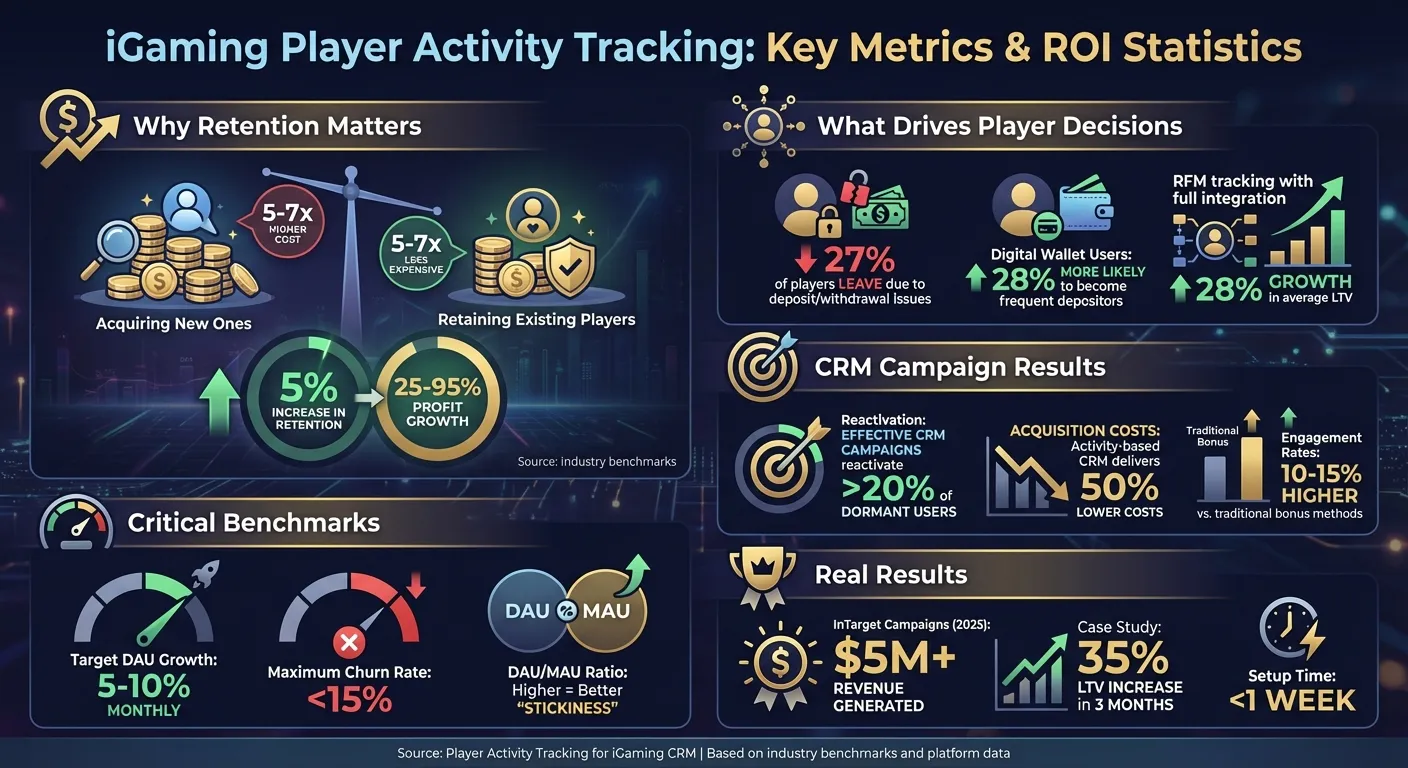 Key Player Activity Metrics and ROI Statistics for iGaming CRM
Key Metrics for Tracking Player Activity
Daily Active Users (DAU), Monthly Active Users (MAU), and Session Patterns
Daily Active Users (DAU) is the number of unique players who do something on the platform in a day: log in, place a bet or make a deposit. Monthly Active Users (MAU) is the same count over 30 days. The DAU/MAU ratio (the “stickiness ratio”) shows how often the average active player comes back. Session duration and frequency separate players who are deeply engaged from those who log in briefly.
Read active players next to revenue. If revenue rises while the number of active players does not, the platform depends on a small group of high-value players, and it is exposed if they leave.
These figures normally come from the platform’s own reporting or from web analytics. A CRM may not hold them: InTarget, for example, shows active players and depositors per period on its Overview dashboard but has no DAU/MAU report and no session-length data.
Recency, Frequency, Monetary (RFM) Analysis
RFM analysis categorizes players by how recently they were active, how often they engage, and how much they spend. For example, a VIP player might have been active yesterday, logged 15+ sessions in a month, and deposited over $1,000. A player who hasn’t logged in for 35 days, plays fewer than five sessions monthly, and deposits less than $100 could be new or at risk of churning.
The segments tell you what to send. A player with high activity and low spending is a candidate for a deposit bonus. A high spender whose activity is declining needs a re-engagement offer before the gap gets longer.
Deposit Patterns and Lifetime Value (LTV)
Deposit frequency shows a player’s confidence in the platform. A small group of high-value depositors usually accounts for a large part of deposits, so identify them and watch their rhythm first.
Monitor Bonus ROI, the revenue a promotion generates divided by what it costs. Below 1.0, the promotion is subsidizing gameplay. Watch failed deposits and slow withdrawals as well: payment problems are a common reason players give for leaving.
Break LTV down by acquisition channel and game preference to see which sources bring players who stay.
Technologies and Methods for Player Activity Tracking
Tracking player activity accurately relies on a mix of client-side and server-side technologies working together. On the client side, cookies and tracking pixels capture page views and clicks. Meanwhile, Player IDs connect all key activities – like deposits, game sessions, spin counts, and win totals – to specific loyalty accounts, creating a detailed timeline from login to withdrawal.
Event-based tools like Google Analytics 4 are designed to follow the entire player journey across websites and mobile apps. For operators managing multiple brands, platforms such as Voluum Tracker provide comprehensive tracking across hundreds of domains. However, client-side tracking can face challenges in regulated markets. To address this, Server-to-Server (S2S) tracking steps in, sending data directly between servers. This method ensures greater accuracy, particularly for financial transactions, while also offering better privacy and control over data.
For operators prioritizing privacy, tools like Matomo grant full data ownership while maintaining GDPR compliance. Behavioral analytics platforms like Fullstory can also be invaluable, identifying friction points – such as repeated form errors – so that user experience issues can be resolved quickly.
A CRM sits on the server side of this picture. InTarget, a CRM for iGaming operators, does not follow page views with pixels or cookies. It takes the platform’s own records, either by pulling them from the platform’s API on a schedule or by the platform pushing them to InTarget’s API: players, transactions, wallets and balances, bonuses, casino game sessions, sports bets, logins and loyalty data. Amounts are converted into the project currency at the rate of the transaction date, so deposits in different currencies compare directly.
Nobody is upgraded to VIP automatically. A casual player who makes a large deposit matches a “large depositors” segment the next time that segment is opened or used, and a campaign that starts on the Deposit event can react to that deposit when it arrives. In 2026, InTarget clients have traced more than €15M in revenue to their campaigns through conversion attribution.
“The ROI tracking alone pays for itself. We finally know which campaigns drive deposits and which don’t.” – Daniel V, Casino Manager
Attribution depends on tagged links. In InTarget, links in email, SMS, push, on-site, WhatsApp and Messenger messages are tagged automatically down to the campaign and the step: utm_source=InTarget, the channel as utm_medium, and a utm_campaign value that carries the campaign and step IDs, or a refcode with the same value if you prefer refcodes. That is what makes per-step attribution possible.
Using CRM Platforms for Player Activity Insights
Unified Event Tracking and Attribution Models
Modern CRM platforms bring a player’s logins, bets, deposits and messages into one record, which makes it possible to follow one player across every touchpoint.
Attribution models decide which marketing effort gets credit for a deposit:
- First-click attribution credits the initial interaction, like a promotional email that led to signup.
- Last-click attribution credits the final touchpoint before a deposit, such as a push notification.
- Multi-touch attribution spreads credit across all interactions: an email, an SMS reminder and a push notification before the deposit each get a share.
Ask each vendor which of these it supports. InTarget uses one rule per message step: a conversion is a successful real-money deposit made within a conversion period (hours to months, one day by default) after the message was delivered, opened or clicked, whichever you choose, or a deposit that carries the step’s refcode. The campaign report then shows deposits and converted players per step and per channel, so you can see whether SMS or email brings more deposits from a given segment. It has no first-touch or multi-touch model, and it attributes deposits, not GGR.
Where InTarget Fits
InTarget is built for online casinos and sportsbooks with roughly 500 to 150,000 monthly players. Each player has one card with these sections: profile, transactions, casino games (sessions), sports bets, bonuses, logins, contacts, communications sent, locks (blocked or self-excluded), loyalty, and predictions (churn probability, value tier, Player State).
The card’s timeline mixes 16 kinds of events in one stream, among them registration, logins, deposits, withdrawals, game sessions, bets, bonuses, messages, and campaign and segment entries. A manager can read in order that a player deposited, played a slot, received a push, entered a campaign and deposited again.
What it does not record: session length, DAU/MAU, page views or clicks on the site, and who is online now. There is no RFM score. Value is a Monetary & Frequency Score with five tiers (Whale, High, Mid, Low, Micro), and recency is Player State (Active, Cooling, At Risk, Dormant, Dead). There is no NGR, LTV or ROI report, and bonus cost is not tracked.
Segments are built from the same data, with about 190 conditions, and are evaluated against current data each time they are used. Questions in plain language are asked from Claude or another AI app connected through the InTarget MCP: “Which players deposited more than €100 last week and have not logged in for three days?” is answered with a segment, and “How did the reload campaign’s steps convert?” from campaign statistics. Integration goes through the platform’s API and is typically live in about a week.
Best Practices for Retention Using Player Activity Data
Triggered Campaigns and Personalized Messaging
A triggered campaign reacts to something a player did or did not do. The standard example: a player has not been active for seven days and gets a reactivation message built around the games they play, be it slots, sports betting or live dealer tables.
In InTarget a campaign starts from one of six events (Registration, Login, Transaction, Deposit, Withdrawal, Casino game), from a segment, from a data-driven segment, or for all players. Inactivity is not an event, so the seven-day case is built in one of two ways. Start from a segment with Time From Last Login is greater than 7 days. Or start on Deposit and add a Wait window step that asks “did they deposit again within 7 days?” and sends the message down the False branch. The message can name the player’s favorite casino game through a template variable.
Track which channel works for each group. Each message step shows sent, delivered, opened and clicked, and the Communication Performance report breaks delivery, open and click rates down by channel, campaign and time.
Two items from the usual playbook sit outside InTarget. Live chat and support history are not part of it. Loyalty tiers are run by the operator’s platform: InTarget reads loyalty status and points and can use them in conditions and templates, but it does not move players between tiers.
Predictive Analytics for Proactive Engagement
A predictive model flags players who are likely to leave before they have stopped playing. In InTarget this is churn probability. A machine-learning model, run daily, reads 20 features (deposit frequency and gaps, gameplay, logins, withdrawal recency) and gives each player the probability of making no deposit in the next 7, 14 and 30 days. The product’s risk bands are Low under 30%, Medium 30 to 50%, High 50 to 70% and Critical from 70%. The model scores players with a deposit and casino play in the last 60 days; sportsbook-only players get no score.
The score is a condition in segments and campaign flows. “Day-14 Churn is greater than or equal to 70” is a segment that can start a retention campaign, and a True/False step inside the flow can send high-value players down one branch and everyone else down another. A campaign started from a segment enrolls the players who match at launch.
Player State covers the same ground without a model: Active, Cooling, At Risk, Dormant or Dead, measured against the player’s own usual gap between deposits. There is no predicted LTV and no other propensity score.
To judge the result, use retention by first-deposit cohort (the Retention Metrics report), deposits per campaign step, and an A/B test step in which one branch receives no message and serves as the control group.
Conclusion
Start by checking what your platform records and whether it reaches the CRM: logins, deposits, game sessions, bets. Build two segments from it, players who are slowing down and high-value players who are slowing down, and attach one campaign to each. Use web analytics for what happens before login, and see the overview of revenue analysis tools for figures such as NGR and bonus cost, which InTarget does not report.
“InTarget transformed our retention strategy completely. We increased player LTV by 35% in just 3 months. The automation capabilities are incredible, and the iGaming-specific features save us hours every single day.” – Vlasta C, Head of Retention
Activity data also serves responsible gaming and fraud prevention. The deposit and login patterns that mark a churn risk can also mark a player who needs a limit, not an offer.
Frequently asked questions
How can tracking player activity help improve retention in online gambling?
Activity data shows which players are slowing down before they stop: fewer logins, a longer gap since the last spin or bet, a deposit that is overdue against the player’s usual rhythm. With that you can contact the right players with an offer matched to the games they play, instead of sending one bonus to everyone, and you can leave active players alone. In InTarget these signals are segment conditions and Player State, and a daily churn model adds the probability of no deposit in the next 7, 14 and 30 days.
What tools are necessary to effectively track player activity in iGaming?
Three layers. The gaming platform records the events: registrations, logins, deposits, withdrawals, game sessions, bets, bonuses. A CRM receives them, either by pulling from the platform’s API on a schedule or by the platform pushing them, and attaches them to one player record so they can be used in segments and campaigns. Web analytics covers what happens before login: page views, clicks and traffic sources. A CRM such as InTarget does not record on-site clickstream or session length, so keep an analytics tool for that.
What are the advantages of using InTarget for small iGaming operators?
InTarget is built for operators with roughly 500 to 150,000 monthly players. It connects through the platform’s API and is typically live in about a week, with free data migration and a dedicated support manager, from €750 per month. The CRM manager works in it directly: one player card with a timeline of events, a segment builder with about 190 conditions, automated campaigns across email, SMS, push, on-site messages, WhatsApp, Facebook Messenger and Instagram, six reports, and deposits attributed to each campaign step. Questions in plain language are asked from Claude or another AI app connected through the InTarget MCP.