

Geo-targeting in iGaming push notifications means sending location-based messages to players. This approach helps operators comply with gambling regulations and deliver personalized, timely offers to players based on their location. Here’s how it works:
- What it does: Targets players by city, state, or geofenced areas (300–500 meters) using GPS, IP addresses, Wi-Fi, or Bluetooth.
- Why it matters: Ensures legal compliance by sending promotions only where gambling is allowed, while boosting player engagement with relevant offers.
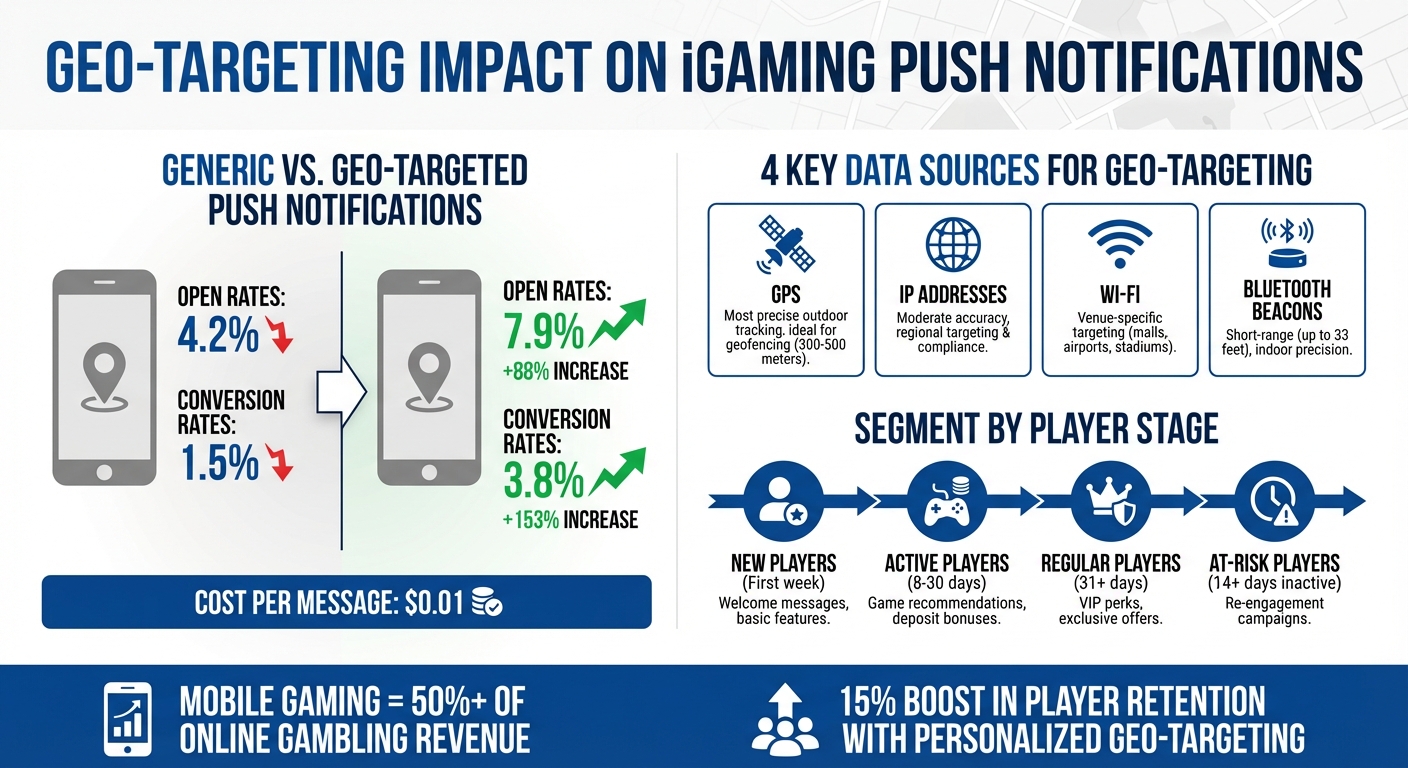
- How it helps: Increases open rates (up to 7.9%) and conversion rates (up to 3.8%) by tailoring messages to player habits and locations.
For small and mid-sized operators, tools like InTarget simplify geo-targeting with features like real-time segmentation, compliance automation, and cost-effective push notifications at just $0.01 per message. By combining precision targeting with clear privacy practices, operators can improve player retention and maximize ROI.
Geo-Targeting Impact on iGaming Push Notification Performance
How Geo-Targeting Works in Push Notifications
Location Data Sources
Push notifications for iGaming leverage four key data sources to pinpoint player locations. GPS offers the most precise outdoor tracking, making it the backbone of geofencing – those virtual zones that trigger notifications when someone enters or exits a specific area. IP addresses provide moderate accuracy, ideal for regional targeting or ensuring players are in states where your platform is licensed to operate.
Wi-Fi triangulation comes into play when users connect to networks in places like malls, airports, or stadiums, making it perfect for location-based promotions. On the other hand, Bluetooth beacons excel at short-range targeting, with a range of up to 33 feet. These are particularly effective for indoor spaces, like sending a special offer when a player steps into a physical casino or sportsbook.
Each of these data sources serves a distinct purpose: GPS is great for outdoor geofencing, IP addresses help with regional compliance, Wi-Fi targets specific venues, and Bluetooth beacons handle precise proximity marketing. The trick is choosing the right tool for your campaign’s goals.
Setting Targeting Parameters and Segments
Once location data is collected, the next step is setting up targeting parameters to determine when and where notifications should be sent. For example, geofences – typically set between 300 and 500 meters – can trigger messages when players enter, exit, or spend time in a designated area.
Location data becomes even more powerful when combined with player lifecycle stages. For instance:
- New players (first week): Send welcome messages introducing basic features.
- Active players (8–30 days): Offer game recommendations or deposit bonuses.
- Regular players (31+ days): Highlight VIP perks or exclusive offers.
- At-risk players (inactive for 14+ days): Launch re-engagement campaigns to bring them back.
To avoid overwhelming users, apply frequency capping to limit how often notifications are sent. Additionally, integrating the SDK and setting up permissions ensures accurate, real-time segmentation based on location.
Next, let’s explore how these strategies translate into better engagement and more efficient marketing efforts.
Benefits of Geo-Targeting for iGaming Operators
Higher Player Engagement
Location-based push notifications outperform generic messages by delivering content that’s both relevant and timely. For example, sending notifications about a local sports event or a promotion specific to a player’s state ensures players receive offers that resonate with them, rather than generic campaigns they might ignore.
The stats back this up: geo-targeted push notifications nearly double open rates, increasing from 4.2% to 7.9%, and conversion rates leap from 1.5% to 3.8%. This significant improvement can transform campaign results. With mobile gaming now contributing over 50% of all online gambling revenue, fine-tuning push notifications is more important than ever.
Consider this: between 2023 and 2024, a casino operator with users in Finland and Estonia used CRM for iGaming with real-time customer segmentation to send personalized offers based on deposit tier, game preferences, and language. By targeting English-speaking players with English-language deposit bonuses, they achieved a 15% boost in player retention over a year. This success wasn’t a fluke – it came from recognizing players as individuals rather than using blanket messaging.
Boosting engagement like this also ensures marketing budgets are used more effectively.
Better Marketing Efficiency
Geo-targeting helps you avoid wasting marketing dollars by focusing efforts on players who are likely to convert. For instance, if a promotion is only valid in specific jurisdictions, there’s no reason to notify players who aren’t eligible. By narrowing the audience to the right players, you save resources and improve campaign performance.
Push notifications are particularly cost-effective, averaging just $0.01 per message, compared to $0.05–$0.10 for SMS. When combined with geo-targeting, this low-cost channel becomes even more powerful, delivering a high return on investment while minimizing unnecessary spending. Targeted notifications ensure your budget is directed at players who matter, not wasted on those who can’t act on your offers.
But geo-targeting isn’t just about engagement and efficiency – it’s also a critical tool for staying compliant.
Meeting Regulatory Requirements
Geo-targeting does more than enhance marketing; it ensures your platform stays within legal boundaries. Gambling laws differ significantly across states and countries, and sending promotions to players in regions where gambling is restricted can lead to fines, license suspensions, or worse. With geo-targeting, you can ensure your push notifications only reach players in jurisdictions where your platform is legally allowed to operate.
"Any player engagement activities must adhere to different regulations per market that observe responsible gambling." – Delasport
In addition to blocking promotions in restricted areas, geo-targeting supports responsible gambling practices. It allows you to send targeted messages offering self-exclusion options or access to support resources, as required by local regulations. This not only keeps your platform compliant but also builds trust with players, showing them you’re committed to operating responsibly and ethically.
Best Practices for Geo-Targeting in iGaming
Define Your Campaign Goals First
Before launching geo-targeted push notifications, nail down your campaign’s purpose. Are you aiming to increase deposits, re-engage inactive players, or promote a special bonus? While push notifications are effective, many operators also integrate SMS marketing for iGaming to reach players offline. Your objective will shape everything from the message content to the audience you target.
Choose metrics that align with your conversion path and comply with local regulations. For instance, if you’re running campaigns in California, you’ll need to follow CCPA guidelines and include responsible gambling messages where required by law.
"Testing different ideas and approaches when location is taken into account can create very interesting insights–and often much different conversion rates." – Neil Patel
The industry is shifting toward hyper-local targeting – not just country-wide campaigns but messages tailored to specific cities or even zip codes. This allows you to connect promotions to local sports events, weather updates, or cultural happenings, creating a deeper connection with players.
When your goals are clear, it becomes easier to build precise, location-based segments that deliver results.
Build Location-Based Player Segments
Once your objectives are defined, use detailed location data combined with behavioral insights – like deposit habits, favorite games, and activity levels – to create segments that are more likely to convert.
Customize offers based on a player’s location and tenure. For example, geofencing can trigger notifications when a player enters a state where your sportsbook operates. Sending a welcome offer at just the right moment feels timely and engaging, rather than intrusive.
Follow Data Privacy Laws
Always secure explicit consent for both push notifications and location tracking. Be transparent about why you need location access – phrases like "to provide local jackpot updates" or "to verify eligibility in your area" can boost opt-in rates by showing players the value they’ll receive.
Keep notifications limited to avoid overwhelming your audience. Too many can lead to opt-outs or even spam complaints, which could land you in hot water with local advertising laws. Make sure your campaigns meet all relevant regulations, whether it’s GDPR in Europe, CCPA in California, or specific responsible gambling requirements.
Compliance isn’t just about avoiding penalties – it’s about protecting your license, building trust with your players, and ensuring your geo-targeting efforts remain effective over the long haul.
Using InTarget for Geo-Targeted Push Notifications
Geo-targeting is a game-changer for push notification campaigns, especially in the iGaming world. For smaller operators, the right tools can make all the difference, and that’s where InTarget steps in. It simplifies the process, making advanced geo-targeting accessible and effective.
InTarget’s Geo-Targeting Features
InTarget helps small and mid-sized iGaming operators segment players by location and launch targeted push campaigns or optimize their email marketing for iGaming without needing a dedicated data team. Its built-in AI assistant provides instant insights, answering questions like, “Which players haven’t deposited in the last 10 days?” based on actual user activity.
The platform also tracks real-time player behavior, allowing notifications to be triggered by events like live games, betting trends, or even when a player enters a specific area. For instance, operators can send a welcome bonus offer as soon as a player enters a licensed state. Plus, its compliance automation ensures operators stay on the right side of regional privacy laws and responsible gambling policies, honoring self-exclusion requests and other regulations.
These capabilities make InTarget a flexible and powerful choice for emerging operators looking to maximize their reach without unnecessary complexity.
Why InTarget Works for Small and Mid-Sized Operators
InTarget is designed with smaller operators in mind, offering tools that streamline operations without the need for large teams or lengthy setup times. Unlike many enterprise platforms, which can take weeks or even months to implement, InTarget is up and running in just a few days. Its intuitive interface is built for marketing teams, not IT specialists, making it easy to use right out of the gate.
| Feature | InTarget | Enterprise Platforms (Optimove, Fast Track) |
|---|---|---|
| Setup Time | Days | Several weeks to months |
| Data Team Required | No (AI-driven) | Often requires dedicated analysts/IT |
| User Interface | Simple, marketing-focused | Complex; requires extensive training |
| Pricing Model | Transparent and scalable | Custom enterprise pricing with long-term commitments |
The platform’s transparent pricing structure is another big win for smaller operators. It eliminates the need for expensive, multi-year contracts while still delivering enterprise-level geo-targeting features like segmentation, real-time triggers, and compliance checks. With InTarget, you get the power of advanced tools without the hefty price tag or complicated setup.
Conclusion
Geo-targeting takes push notifications to the next level, turning them into location-specific messages that resonate with users, boosting both engagement and conversion rates. This approach not only enhances user interaction but also delivers a strong return on investment – an essential factor for operators working within tight budgets.
To make the most of geo-targeting, start by setting clear campaign objectives and creating precise, location-based audience segments. Always prioritize data privacy to ensure your messages are meaningful without crossing boundaries. Tools like geofencing can help you send timely offers when users enter specific areas, while frequency capping ensures you avoid overwhelming them with notifications. Transparency about why you’re requesting location access also builds trust with your audience.
With push notifications costing approximately $0.01 per message and achieving open rates between 50-80%, geo-targeted campaigns stand out as a highly cost-efficient way to connect with players. For small and mid-sized operators, InTarget provides enterprise-level geo-targeting solutions with user-friendly tools and clear pricing. Pairing this efficiency with InTarget’s seamless platform can help you increase deposits, improve retention, and maximize player lifetime value – all while adhering to local regulations.
FAQs
How does geo-targeting help iGaming operators comply with gambling laws?
Geo-targeting is a key tool for iGaming operators to ensure compliance by using a player’s location to align with region-specific gambling laws. In the U.S., for instance, operators must confirm a player’s location to verify they are in a state where online gambling is permitted before sending push notifications. Meanwhile, in the EU, regulations such as GDPR demand explicit user consent and enforce strict data privacy rules, all of which depend heavily on location data.
By adapting messages and features to meet local regulations, geo-targeting not only helps operators stay within legal boundaries but also supports responsible gambling practices.
How does InTarget benefit small iGaming operators?
InTarget is tailored for small to mid-sized iGaming operators, providing straightforward tools to simplify marketing efforts without the hassle of complex, large-scale systems. One standout feature is its AI-powered player segmentation, which helps operators pinpoint and engage specific customer groups with precision.
Thanks to its quick setup and intuitive interface, teams can easily create, launch, and monitor campaigns – no developers or data analysts required. InTarget streamlines workflows, enabling smaller operators to deliver high-level results while remaining nimble and budget-conscious.
How can iGaming operators personalize geo-targeted push notifications while protecting player privacy?
To strike a balance between personalization and privacy in geo-targeted push notifications, the first step is to secure clear and explicit consent from players before collecting their location data. This is crucial for meeting the requirements of regulations like GDPR in the EU or state-specific laws in the U.S., which mandate transparency and documented consent for data usage.
After obtaining consent, focus on using anonymized and aggregated data to craft personalized messages without exposing sensitive information. For instance, instead of working with raw IP addresses, you can target players using broader indicators like their country, preferred currency, or device type. Tools like InTarget are useful here, as they automatically anonymize location data while still enabling marketers to segment and analyze player behavior effectively.
Finally, adopt strict data management practices to safeguard geolocation data. Only retain this information for as long as it’s genuinely needed, restrict access to authorized personnel, and always provide opt-out options in your push notifications. By following these steps, operators can create relevant, location-based offers while respecting player privacy and staying within legal boundaries.