
At most operators a small share of players accounts for a large share of deposits, and each one who leaves is expensive to replace. VIP programs exist to keep them, with tiered rewards, personal attention and perks that go beyond a bonus. This article covers how to identify high rollers, how to structure the program, what a CRM can automate and what stays with a human host, and how to measure whether the program works.
The working parts are player segments built on deposit data, perks matched to how each VIP plays, and a host who makes contact before the player has gone quiet. A CRM for iGaming keeps every deposit, bet and message of a player in one place, so the host does not work from memory.
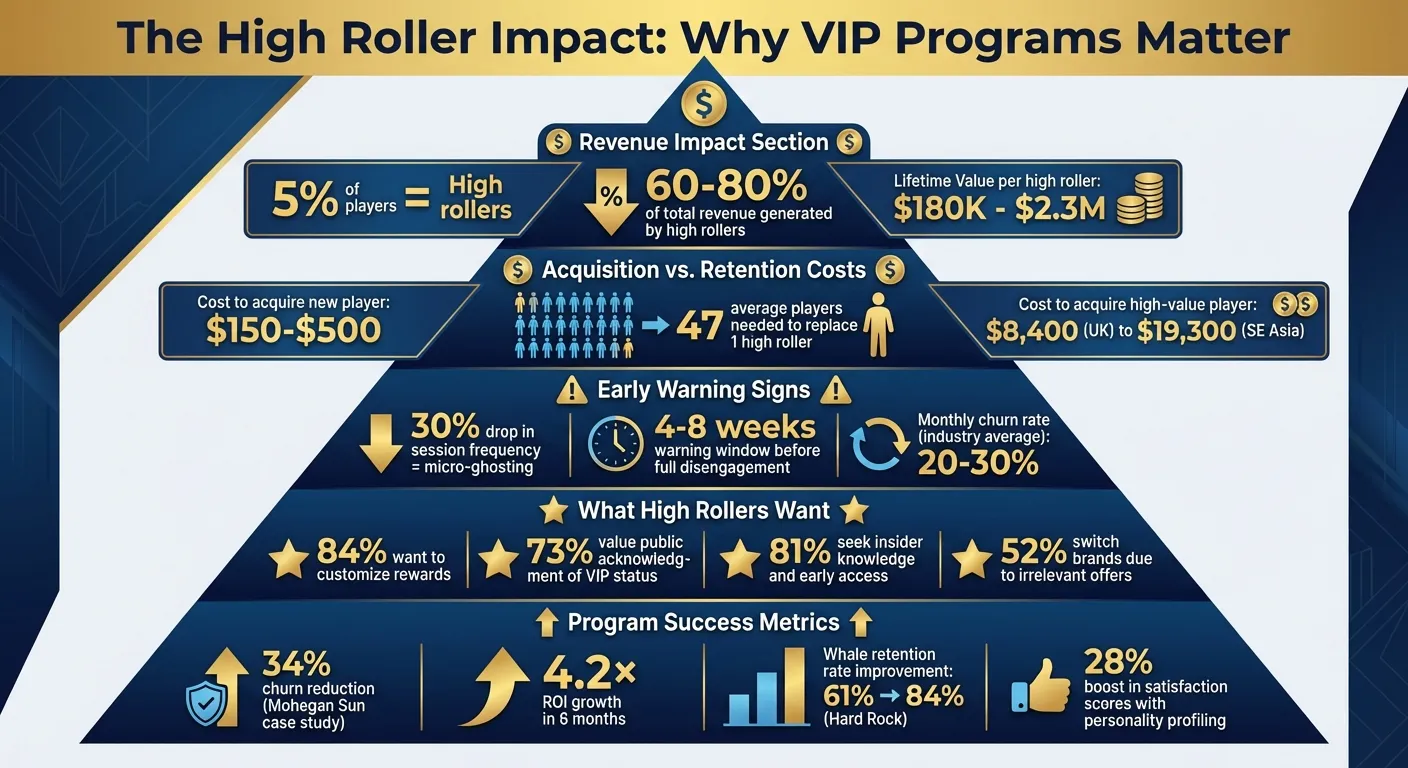 High Roller VIP Program Statistics: Revenue Impact and Retention Metrics
Who High Rollers Are and What They Want
Understanding what this group wants comes before any lifecycle marketing plan for it.
How to Identify High Rollers in iGaming
Operators identify high rollers by deposit amounts, wagering over time and overall value. There is no standard threshold. Set yours relative to your own player base, for example the top few percent by real-money deposits.
How much a player spends is half of the picture. The other half is whether the pattern is holding. A VIP whose logins thin out, whose bets get smaller or whose usual deposit is overdue is showing early signs of churn before the account goes silent. That is the window in which a host can still change the outcome.
What High Rollers Expect from Operators
Standard perks are not enough for this group. In practice VIPs look for three things:
- Recognition. Visible status, a named host, being treated as someone the operator knows.
- Access. Early entry to new games and events, and information before everyone else gets it.
- Control. A say in which rewards they receive, and in how and when they are contacted.
High rollers are not one type. Some want a relationship with a host. Others want fast withdrawals and to be left alone. Ask on first contact, record the answer, and match the host and the contact style to it.
How VIP Programs Boost High Roller Retention
Finding and Segmenting Your High Rollers
Start with the value cut, then split by product. Two players depositing the same amounts need different approaches if one prefers live dealer games and the other bets on sports.
In InTarget the value cut is ready-made. The Intelligent Segment ranks depositors within the project on a Monetary & Frequency Score (80% monetary, 20% frequency, on lifetime real-money deposits) and labels them Whale (the top 3%), High, Mid, Low or Micro. Game preference comes from the Casino and Sportsbook condition groups: Favorite Game, Casino Game Total Bet Amount by game type, Sport Name.
For early warning, three conditions do the work:
- Last Player State is equal to Cooling or At Risk. The state compares the days since the last deposit with the player’s own usual gap between deposits, so it reacts sooner for a VIP who deposits every few days.
- Day-7 Churn, Day-14 Churn or Day-30 Churn: the probability, from a model run daily, that the player makes no deposit within that horizon. It covers players who deposited and played casino games in the last 60 days.
- Time From Last Login is greater than 10 days, as the simple version.
“Whale or High, and At Risk” is one segment. It is evaluated against current data each time it is opened or used, so the list a host opens is never a stale export. InTarget has no session-length data and does not send alerts by itself; how the list reaches a host is covered in the automation section below.
Creating Tiered Loyalty Levels
Set clear thresholds for tiers such as Bronze, Silver, Gold, Platinum and an invitation-only top level. Each tier should add something the player can feel: faster withdrawals at Silver, a dedicated account manager at Gold, round-the-clock concierge at Platinum. Match the rewards to how the player plays. A sports betting bonus is wasted on someone who only plays live casino.
Tier rules, points and upgrades are run by the loyalty engine of your platform. InTarget does not calculate tiers or move players between them. It reads loyalty status and points from the operator’s data, and they can then be used as segment conditions (Loyalty Level, Loyalty Status, Loyalty Current Points) and as variables in message templates, for example to show a player their current status and points balance.
Offering Personalized Rewards and Incentives
Generic bonuses are the weakest tool for this group. An experience chosen for the player (a dinner, event tickets, a trip) can do more than a cash bonus of the same cost, and it does not teach the player to wait for the next offer.
Give hosts a budget and the authority to solve a VIP’s problem directly. A host who can fix a withdrawal delay or a complaint on the first call does more for retention than an automated points statement.
Communication preferences are part of personalization. Some VIPs want a messenger, some email, some a call at set hours. Keep the preference where the host will see it, and respect it in automated sends as well: in InTarget, delivery intervals and Time window steps hold messages to the weekdays and hours you allow, in the player’s time zone.
Using Technology and Automation for VIP Programs
Automating VIP Campaigns with CRM Tools
Handling every VIP touchpoint by hand stops working beyond a few dozen players. A specialized CRM platform takes over the routine messages so that hosts spend their time on conversations.
In InTarget a VIP flow is an automated campaign started from a segment or from an event (Registration, Login, Transaction, Deposit, Withdrawal, Casino game). The flow can send email, SMS, push, on-site, WhatsApp, Facebook Messenger and Instagram messages, wait, and branch on any segment condition. Three flows cover most VIP programs:
- New large depositor. Start on Deposit, check the amount in a True/False step, and send an introduction from a host.
- Slipping VIP. Start on Deposit, then add a Wait window step that asks “did they deposit again within 10 days?” The False branch sends a personal message.
- Host hand-off. InTarget does not notify account managers itself. A Webhook step in the flow calls the operator’s own tool (a VIP desk system, a team chat), so the host gets the task where they already work.
Integration goes through the platform’s API and is typically live in about a week.
Using AI to Personalize VIP Experiences
Be precise about what AI does here. In InTarget the machine-learning component is the churn model. Run daily, it reads deposit frequency and gaps, gameplay, logins and withdrawal recency, and gives each scored player the probability of not depositing in the next 7, 14 and 30 days. The product groups the result into risk bands: Low under 30%, Medium 30 to 50%, High 50 to 70%, Critical from 70%. A flow can branch on it, so a Whale in the High band gets a call from a host and a Mid player in the same band gets an email.
The model does not suggest bonuses or work out the right cashback, and there is no predicted lifetime value. How generous to be is your decision, and it can be tested. An A/B test step splits players between two branches in any proportion, and a branch with no message works as a control group, so deposits with and without the offer can be compared.
For questions in plain language, the InTarget MCP connects Claude or another AI app to the account. “Which Whale players have not logged in for seven days?” is answered from a segment, and “How did the steps of last month’s cashback campaign convert?” from campaign statistics, within the permissions of the user who signed in.
Adding Gamification to Keep VIPs Engaged
Missions, achievement badges, leaderboards and challenges give a VIP a reason to come back that is not a bonus. A “100 Spins Challenge” with a small reward at the end, or a monthly leaderboard of top wagerers, adds progress the player can see.
These mechanics run in the operator’s platform or in a gamification tool. InTarget has no missions, leaderboards, levels or point systems of its own. Its part is the messaging around them: announcing a challenge to the right segment and, where the platform sends loyalty status and points, using them in conditions and templates.
Measuring and Improving VIP Program Performance
Key Metrics to Track for VIP Programs
- Retention of the VIP tier: of the players in the tier at the start of a period, how many deposited again during it.
- Average monthly deposits and average bet size per VIP.
- Frequency of play: deposit days and login days per month.
- Churn in the tier, and how many of those players a host reached before they left.
- Lifetime value per VIP, from your BI or finance data.
- Net Promoter Score (NPS) or direct host feedback, for satisfaction.
In InTarget, the Retention Metrics report shows cohorts by first-deposit date with retention rate and cumulative ARPPU, and Transactions Metrics shows deposits and withdrawals over time. Reports cannot be filtered by a segment, so tier-level figures come from the segment itself: its member list has columns such as Total Deposit Amount, Total Deposit Count, Average Deposit Amount and Last Deposit Date, and it exports to CSV. There is no LTV report and there are no alerts.
Adjusting VIP Perks Based on Data
Act on what the numbers show. If VIPs redeem one kind of reward and ignore another, move the budget. If a perk has no visible effect on deposits against a control group, drop it.
In InTarget a campaign’s statistics show deposits and converted players per step and per channel, counted within a conversion period you set after the message was delivered, opened or clicked. Comparing a branch that received the perk with a branch that received nothing gives the uplift. The product does not calculate it for you.
For dormant VIPs, skip the generic bonus email. A personal call or message from the host with no offer attached is the first step. The bonus is the second, if the first gets no answer.
Before and After: How to Run the Comparison
Measure before and after every program change, by tier. Record the baseline for one full period: tier retention, average monthly deposits, the share of slipping VIPs a host contacted. Change one thing. Compare the same figures for the next period, and against a control group where you can hold one back. Include the cost of the change (comp budget, host time), which is in your finance data and not in the CRM.
Conclusion
Technology identifies the VIP and the moment. A host does the retaining. Set up the value tier and the slipping-VIP segment first, route that list to a named host every day, and measure tier retention before adding perks. Expand the program only where a controlled comparison shows that deposits moved.
Frequently asked questions
What qualifies as a “high roller” for my VIP program?
There is no industry-wide threshold. Define the group relative to your own player base, for example the top few percent by real-money deposits, and then check how they bet: stakes that stay high across sessions and months, not one large bet. In InTarget the ready-made cut is the Intelligent Segment, which ranks depositors within the project and labels the top 3% as Whale and the next tier as High.
How can I detect VIP churn early beyond a drop in deposits?
Compare each VIP with their own habits instead of a fixed number of days. Signals that show before deposits stop: fewer logins than usual, a longer gap since the last spin or bet, smaller average bets, and a deposit that is overdue against the player’s usual rhythm. In InTarget these are segment conditions (Logins Count, Time From Last Login, Time From Last Spin, Average Spin Amount, Player State), and a daily churn model adds the probability of no deposit in the next 7, 14 and 30 days. Session length is not recorded.
Which VIP perks drive retention without hurting profitability?
Perks with a low marginal cost and a high perceived value: faster withdrawals, a named host who answers quickly, early access to new games, invitations to events, and offers matched to the games the player actually plays. Cash-equivalent bonuses are the expensive kind, so tie them to deposits and measure them: compare a group that received the offer with a control group that did not, on deposits over the following weeks.