

Email marketing for iGaming campaigns can deliver high ROI when done right. The key is precision – leveraging real-time player data, segmenting audiences, and crafting personalized messages to boost engagement and revenue. Poor timing, irrelevant offers, or unoptimized designs can hurt performance. This checklist covers everything from planning goals and segmenting players to optimizing design and testing for better results.
Key Takeaways:
- Set clear goals: Focus on measurable outcomes like deposit increases or reactivating dormant players.
- Segment audiences: Use player behavior (e.g., deposit history, game preferences) to create targeted campaigns.
- Personalize content: Tailor emails with dynamic content, predictive analytics, and player-specific offers.
- Optimize design: Use mobile-friendly layouts, bold CTAs, and consistent branding.
- Test and track: A/B test subject lines, CTAs, and visuals while monitoring real-time performance.
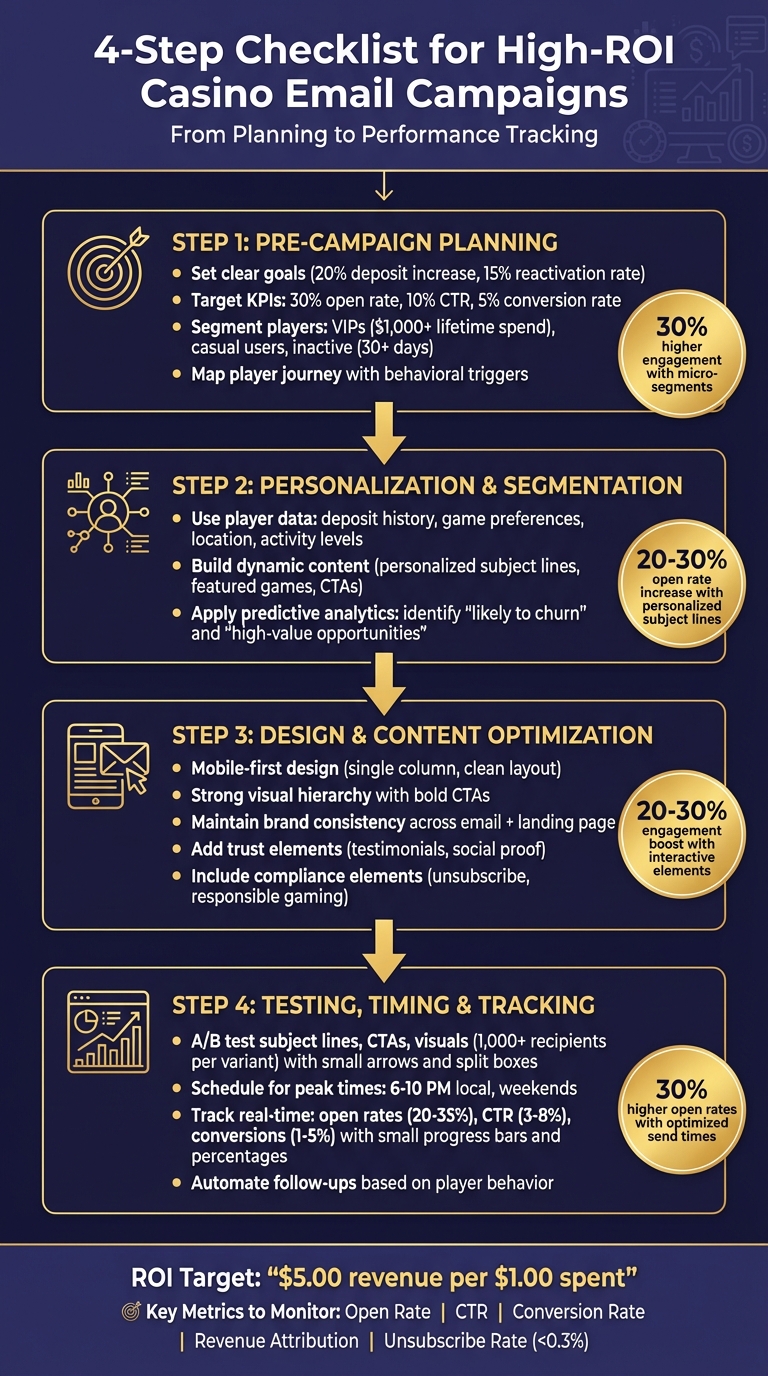
Casino Email Campaign Checklist: 4-Step Process for High-ROI Campaigns
Pre-Campaign Planning Checklist
Set Clear Campaign Goals
Start by defining specific, measurable objectives. Avoid vague goals like "increase engagement" and focus on clear, actionable targets. For example, aim for a 20% increase in deposits among target segments, 15% reactivation of dormant players, or a 25% uptick in tournament registrations.
For promotional campaigns, tie your goals directly to key performance indicators (KPIs). You might target a 30% email open rate, a 10% click-through rate to landing pages, and a 5% conversion rate for deposits or registrations. The most effective campaigns also link these metrics to ROI. For instance, you could aim to generate $5.00 in revenue for every $1.00 spent. Use historical data from past campaigns to set realistic benchmarks that align with your broader player lifecycle marketing strategy.
Once your goals are in place, focus on refining your strategy through precise player segmentation.
Segment Your Player Base
Generic, one-size-fits-all campaigns rarely deliver strong results. Instead, segment your audience based on behavior, preferences, and lifecycle stage. Start by categorizing your players. For example, separate VIPs (players with lifetime spending over $1,000) from casual users, identify high-value depositors who could benefit from deposit-match bonuses, and flag inactive accounts (those with no activity in 30+ days) for re-engagement efforts.
Dive deeper by considering additional player attributes. For instance, segment by game preferences – slot players often respond differently than table game enthusiasts. Location is another key factor, especially for ensuring compliance in regulated markets. Use CRM data to create micro-segments, like recent depositors who haven’t engaged in 14 days. This level of detail can increase engagement rates by up to 30% compared to broader campaigns.
Map the Player Journey
With goals in place and your audience segmented, it’s time to outline the entire player journey. Identify every touchpoint, from the initial email to landing pages, offers, and follow-up messages. A new player might require a multi-step welcome sequence over 14 days, introducing platform features, loyalty programs, and first-time bonuses. On the other hand, a dormant player may need a reactivation sequence with progressively more urgent messaging.
Incorporate behavioral triggers to make your messaging more relevant. For example, set emails to send automatically based on actions like a first deposit, hitting a wagering milestone, or 30 days of inactivity. Tools like InTarget integrate directly with your player database to automate these workflows, ensuring that each message reaches the right player at the perfect moment. This dynamic approach moves beyond static schedules, creating personalized communication that delivers measurable results.
Personalization and Segmentation Best Practices
Use Player Data Effectively
Player data is your secret weapon for creating precise segments. Deposit history, for instance, helps you distinguish high-rollers from casual players, so you can tailor offers accordingly. Game preferences shed light on whether someone loves slots, table games, or poker, giving you the chance to showcase content that fits their interests. Even location data plays a key role – not just for compliance with jurisdictional rules but also for crafting location-specific offers. For example, players within 50 miles might get a different message than those planning a destination visit.
Activity levels are another crucial factor. By separating frequent players from those who play less often, you can fine-tune your targeting. For example, a segment like "VIP locals, slots-focused, 2–4 visits per month, within 50 miles" can outperform generic campaigns, even with a smaller list size. These data-driven segments are the foundation for creating dynamic, personalized content.
Build Dynamic Content
Static emails often fall flat when it comes to engagement. Dynamic content, on the other hand, lets you adapt key elements – like subject lines, featured games, and calls-to-action – based on each player’s profile. For example, a slots enthusiast might see offers for free spins, while a high-depositor could get a deposit-match bonus. This approach doesn’t just make your emails more relevant; it also improves open and click rates without requiring multiple campaigns.
Dynamic content is especially powerful for lifecycle marketing. Take a welcome series, for example: you can highlight different property features – like slots, live dealers, or sportsbook options – based on how a player interacts at signup. With this kind of adaptability, a single campaign can effectively engage multiple segments.
Once your messages are tailored with dynamic content, predictive analytics can take your targeting to the next level.
Apply Predictive Analytics
Predictive analytics help you pinpoint at-risk players and uncover high-value opportunities. With these tools, you can create highly specific segments like "likely to churn", "slots players who could become VIPs", or "players who respond well to hotel offers." This level of precision ensures your campaigns deliver the right message at the right moment.
For example, InTarget’s AI assistant simplifies the process by letting you ask straightforward questions like, "Which players haven’t made a deposit in the last 10 days?" or "Who are the slots players most likely to stop playing soon?" The system instantly provides actionable insights based on real player behavior. This eliminates the need for technical expertise, speeding up decision-making and enabling advanced tactics like send-time optimization and micro-segmentation.
When you combine predictive analytics with detailed segmentation and dynamic content, your campaigns become smarter and more responsive. They adapt in real time to player behavior, driving better engagement and boosting both retention and revenue per campaign send.
Design and Content Optimization Checklist
Apply Email Design Best Practices
Once you’ve segmented your audience and personalized your messaging, the next step is ensuring your email design supports these efforts effectively. A well-designed email can turn engagement into action.
Start by designing emails with mobile users in mind. Since over half of casino emails are opened on mobile devices, much like SMS marketing for iGaming, a single-column layout is essential. Avoid clutter – keep the design clean and focused. Begin with a compelling header that highlights value, like "Your $50 Free Play Expires Tonight." Follow this with concise copy under 150 words and a bold, attention-grabbing CTA (call-to-action) button.
A strong visual hierarchy helps guide readers naturally. Use headers to break up text, dividers to separate sections, and buttons with action-oriented text like "Claim Your Bonus Now" or "Spin Now & Win Big." For added engagement, consider interactive elements like countdown timers or "spin-to-win" offers. These can increase engagement by 20–30%, but make sure they’re mobile-friendly and steer clear of real gambling mechanics to remain compliant.
Maintain Consistency and Compliance
Your email and landing page should feel like a seamless experience. Use the same colors, fonts, logos, and imagery across both platforms. For example, if your email highlights a popular slot game, the landing page should feature the same hero image. This kind of alignment reduces bounce rates and reinforces your brand identity.
Compliance is equally important. Include an unsubscribe link, sender details from a trusted domain like [email protected], and a responsible gaming message such as "Gamble Responsibly – 1-800-GAMBLER." These elements not only meet legal requirements but also help build trust with your audience.
Add Trust-Building Elements
Trust is a powerful driver of conversions. Including social proof, like a short testimonial near the CTA – "Won $500 on slots last week! – John D." – can make skeptics more likely to act. Pair this with a star rating or a player photo for added credibility. Community updates, such as "Join 10,000 players in our weekly tournament," can also communicate momentum and encourage participation without overwhelming the design.
Limit trust elements to one or two per email to keep the layout clean. Personal touches, like leadership messages or milestone celebrations (e.g., birthday bonuses), can also enhance credibility. These additions often lead to higher click-through rates compared to generic promotional emails.
Testing, Timing, and Launch Checklist
A/B Test Key Elements
A/B testing is your go-to tool for fine-tuning email performance. Focus on subject lines, CTAs, and visuals – these are the elements that determine whether players open your email or take action. For example, you can test personalized subject lines like "Sarah, your $50 free spins are waiting" against more generic ones. Industry benchmarks suggest personalized subject lines can increase open rates by 20-30%. Similarly, experiment with CTAs – "Spin Now" versus "Get Bonus" – to find out what resonates best with your audience.
Keep your tests focused by changing only one or two variables at a time, and ensure each variant reaches at least 1,000 recipients. Pay attention to key metrics: open rates (aim for 20-35%), click-through rates (target 3-8%), and conversion rates (look for 1-5% for deposit actions). If a variant’s CTR drops below 2% within the first hour, pause it and scale up the better-performing version. Using dynamic content, like player-specific game thumbnails instead of generic slot images, can also increase CTR by 15-25%.
Schedule Emails for Maximum Impact
When you send emails is just as crucial as what you send. US casino players are most active during the evening hours of 6-10 PM local time and on weekends, so plan your campaigns around these peak times. To maximize open rates, send emails 1-2 hours after these activity windows, which can boost engagement by up to 30%.
For specific campaigns, timing is everything:
- Welcome emails: Send within 24-48 hours of registration during peak activity times.
- Abandoned deposit follow-ups: Trigger at 1, 24, and 72 hours post-abandonment.
- Re-engagement campaigns: Thursday and Friday evenings perform best, with open rates increasing by 25% during these times.
Avoid early morning sends, as deliverability and engagement tend to drop during these hours. Once your emails are scheduled, keep an eye on performance and adjust as needed.
Track Performance in Real-Time
Real-time tracking is a game-changer for email marketing. It allows you to tweak campaigns as they run, ensuring you’re always optimizing. Platforms like InTarget give you instant access to data on open rates, CTR, conversions, and revenue. If your open rate dips below 20% or CTR falls under 3%, pause the campaign and test new content immediately. InTarget also provides detailed insights at the player level, helping you identify which segments are thriving and which need a different approach.
Use automation to act on performance data. For instance, if a player clicks but doesn’t deposit within an hour, send a push notification or SMS with a more enticing offer. If bonus offers aren’t converting well, switch to free spins – this adjustment alone can increase revenue by 15%. Keep an eye on unsubscribe rates, too; staying below 0.3% is a good sign your list is clean and engaged. Real-time tracking isn’t just about fixing issues – it’s about learning and improving with every campaign.
Conclusion
Running successful casino email campaigns isn’t about taking shots in the dark – it’s about sticking to a structured process and letting the data lead the way. This checklist provides a clear path: plan with intention, personalize using player insights, fine-tune your design, and test repeatedly. By blending these steps with the right tools, you can shift from generic email blasts to targeted, behavior-driven campaigns that increase deposits and keep players engaged.
The right tools make all the difference. For example, platforms like InTarget simplify the process by integrating your email system directly into your CRM. This means you can use real-time data – like deposits, game activity, or inactivity thresholds – without needing manual exports or developer help. Plus, the built-in AI assistant allows you to ask specific questions, such as "Who hasn’t deposited in the last 10 days?", and get instant answers. This makes launching highly targeted campaigns a matter of minutes, not hours.
Keep refining your approach by tracking more than just opens and clicks. Focus on metrics like revenue attribution. If a welcome email sequence increases early engagement by 45% or a re-engagement campaign brings back 28% of inactive players, you’ll know exactly where your efforts are paying off. Use these insights to continually improve future campaigns.
FAQs
What player data should I segment by first?
Metrics like deposit frequency, inactivity periods, and game preferences are incredibly useful for segmenting your audience. These insights allow you to create targeted campaigns, such as re-engagement efforts, loyalty rewards, or personalized promotions tailored to specific user behaviors.
On top of that, leveraging real-time activity data – such as recent deposits or gameplay trends – can help you deliver highly relevant messages. This approach not only enhances engagement but also improves retention by addressing user needs at the right moment.
How can I personalize emails without creating multiple versions?
You don’t need dozens of email templates to create personalized messages. Instead, use segmentation and dynamic content tools to tailor emails from a single template.
Group your audience based on criteria like:
- Inactivity: Target players who haven’t logged in for a while.
- VIP Status: Offer exclusive perks to your top-tier users.
- Game Preferences: Recommend games that align with their interests.
Dynamic content blocks make it easy to include personalized offers, names, or even specific game suggestions directly within the email. Tools like InTarget take this a step further by combining real-time segmentation with automation. This lets you send highly tailored messages to large audiences – all without creating multiple versions of your email.
Which metrics best prove email ROI for casinos?
When it comes to proving email ROI for casinos, a few key metrics stand out. Conversion rate is crucial – it shows how effectively your emails encourage players to take action, whether that’s signing up for an event, booking a stay, or trying out a new game. Then there’s open rate, which gives insight into how compelling your subject lines are and how interested players are in your emails. Finally, click-through rate measures how engaging and relevant your email content is by tracking how many recipients click on links.
Together, these metrics create a well-rounded view of how your campaigns are performing and how players are interacting with your emails.