

Push notification CTAs are critical for driving player actions in iGaming. Small changes like switching "Claim Now" to "View Offer" can significantly impact conversion rates. A/B testing helps refine these CTAs by relying on data to optimize wording, timing, design, and personalization. Here’s how you can make your CTAs more effective:
- Test one variable at a time: Focus on elements like action words ("Bet Now" vs. "Claim Bonus") or button color.
- Segment your audience: Group players by behavior, preferences, or platform (e.g., iOS vs. Android) for tailored insights.
- Use clear goals: Define success metrics like click-through rates or deposit completions.
- Leverage tools: Platforms like InTarget simplify testing, segmentation, and tracking.
A/B testing ensures your CTAs resonate with players, driving engagement and conversions. Start small, measure results, and scale what works.
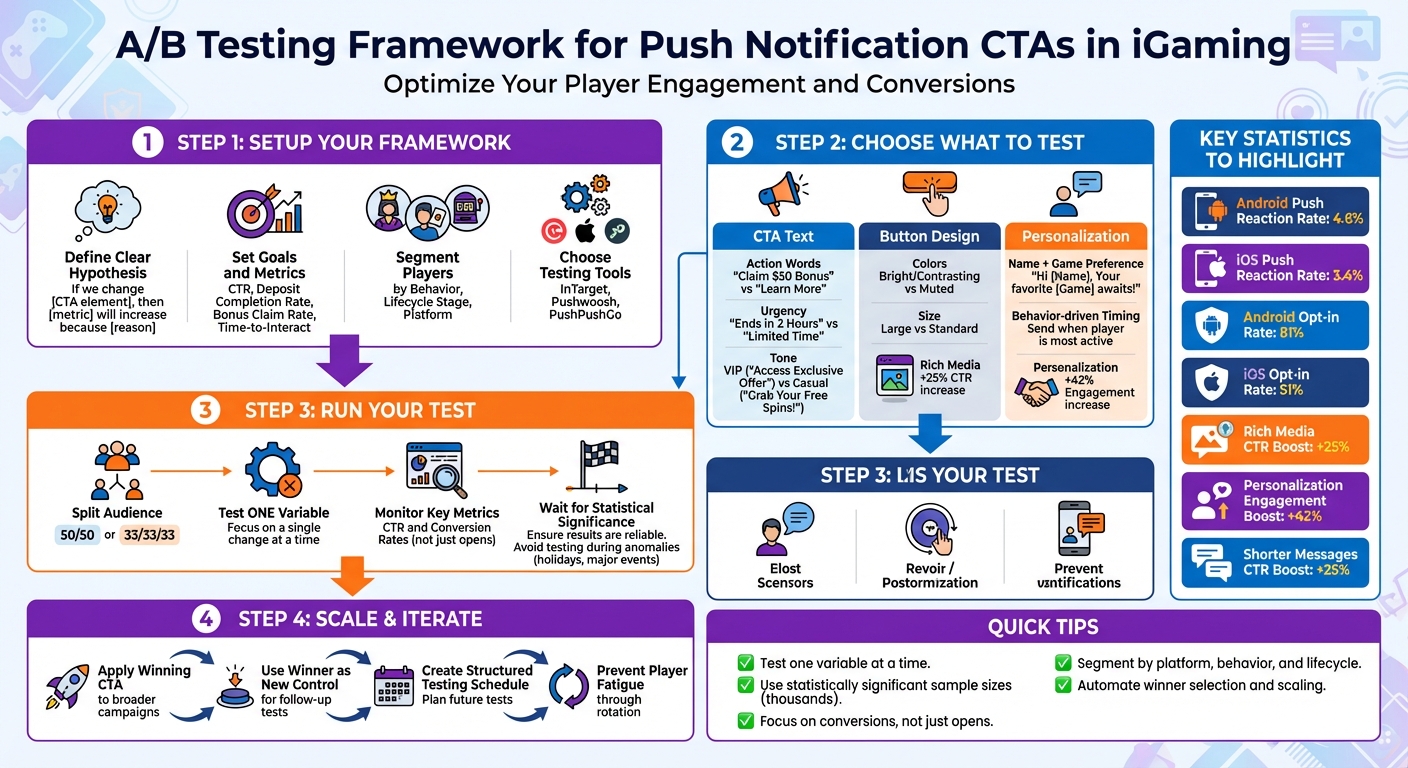
A/B Testing Framework for Push Notification CTAs in iGaming
Setting Up Your A/B Testing Framework
Before diving into A/B testing, it’s crucial to lay a solid foundation. This means defining what success looks like, understanding your audience, and picking tools that streamline the process. Without this prep work, you risk ending up with unreliable data or wasted resources.
Setting Goals and Metrics for iGaming Campaigns
A strong A/B test always starts with a clear hypothesis. Use a format like this: "If we change [CTA element], then [metric] will increase because [reason]." For example, "If we change ‘View Offer’ to ‘Claim $50 Bonus,’ then click-through rate will increase because the dollar amount adds urgency and clarity." This approach ensures your tests have purpose and aren’t just random experiments.
Focus on one variable at a time. For instance, test a CTA’s wording separately from design elements like button color or emoji use. If you change too many things at once, it’ll be impossible to pinpoint what actually worked. For iGaming, track key metrics like click-through rate (CTR), deposit completion rate, bonus claim rate, and time-to-interact (how quickly players engage after receiving a notification). Go beyond just clicks – measure deeper goals, such as completing KYC verification or advancing to a higher loyalty tier.
Use a statistically significant sample size – typically in the thousands – to ensure reliable results. Small tests might seem promising but often fail when scaled. Also, pay attention to platform-specific trends: Android users tend to have higher push notification reaction rates (4.6%) compared to iOS users (3.4%). Segmenting your tests by platform can reveal these nuances.
Segmenting Players for Meaningful Tests
Splitting your audience randomly isn’t enough. To get actionable insights, segment players based on behavior, lifecycle stage, and preferences. For example, group players by deposit frequency (daily vs. weekend depositors), game preference (slots vs. sports betting), or activity level (active, at-risk, or dormant). A CTA that resonates with high-rollers might completely miss casual players.
You can also fine-tune segments using technical and geographic data. Split by location (state or city for localized offers), time zones (to test the best send times), or platform (iOS vs. Android, given Android’s higher opt-in rate of 81% compared to iOS’s 51%). Ensure test groups are randomly divided but statistically similar to avoid skewed results caused by audience differences.
Timing matters, too. Avoid running tests during anomalies like major holidays or big sports championships, as these events can distort behavior. With well-defined segments, you’ll be ready to select a tool that supports these parameters seamlessly.
Choosing the Right A/B Testing Tools
The right tools can make or break your A/B testing efforts. Look for platforms that simplify the process with features like statistical significance calculators to ensure results aren’t due to chance, automated winner selection to scale the best-performing variant quickly, and multi-channel support to test CTAs across push notifications, SMS, and email.
For small to mid-sized iGaming operators, InTarget is a great option. It lets you create player segments, run A/B tests, and track results – all without needing a developer or analyst. Its built-in AI assistant can answer questions like, "Which players haven’t deposited in the last 10 days?" using your own data. This kind of speed is critical when competing for player attention in a crowded market.
Other tools worth exploring include Pushwoosh, which features a Customer Journey Builder for A/B/n testing across multiple channels, and PushPushGo, which can automatically push the winning message to the rest of your audience after a test concludes. Whichever platform you choose, ensure it integrates smoothly with your existing iGaming setup and provides clear, actionable insights to help you iterate quickly and scale successful strategies.
What to Test in Your Push Notification CTAs
With your framework ready, the next step is figuring out which CTA elements can make the biggest difference. Focus on changes that noticeably boost engagement. Three areas tend to have the most impact: the wording of your CTA, the design of your button, and how personalized your message feels.
CTA Text and Action Words
The words you choose for your CTA are critical. Clear, action-driven phrases like "Claim $50 Bonus" or "Bet Now" guide players on exactly what to do and what they’ll get, unlike vague options like "Learn More" or "Click Here."
You can also tweak the tone to fit different player groups. For instance, VIP high-rollers might respond better to polished language like "Access Exclusive Offer", while casual players may prefer something more fun, like "Grab Your Free Spins!" Adding urgency or scarcity can also be effective – try phrases like "Ends in 2 Hours" or "Only 10 Spots Left." To get accurate results, test one element at a time, whether it’s the action word or the urgency component.
But words alone aren’t enough. How you present them visually also plays a big role.
Button Design and Position
The look of your CTA button is just as important as the text. Start by testing colors – bright, contrasting hues like red or orange tend to grab attention faster than muted tones. Button size is another factor; a larger button might stand out better on small screens, but going too big can feel overwhelming.
Interactive elements like emojis or icons can also add appeal. For example, a fire emoji next to "Hot Streak Bonus" can make the CTA pop, though it’s best to use these sparingly. You could also experiment with different formats, such as a traditional button versus a deep link or plain text link. Data shows that using rich media – like GIFs or dynamic images – can increase click-through rates by up to 25%.
Personalization and Dynamic Content
While visuals grab attention, personalization makes your message stick. Generic CTAs often get ignored, but personalized ones – like mentioning a player’s name, favorite game, or recent activity – can make a big difference. For example, "John, Your Blackjack Bonus is Ready" feels much more engaging than "Your Bonus is Ready." Test these personalized messages against generic ones to see what works better.
Dynamic content based on player behavior takes this a step further. If someone frequently plays slots on Friday nights, send a Friday afternoon notification with a CTA like "Spin Your Favorite Slots Tonight." Tools like InTarget’s AI assistant can help you analyze patterns, such as identifying which players prefer slots over sports betting. This allows you to design smarter, behavior-driven tests. Just remember to adjust one personalization element at a time to measure its true impact.
Running and Managing Your A/B Tests
Once you’ve decided what to test, the way you execute it will determine whether you gain actionable insights or waste your efforts. How you divide your audience, track results, and sidestep common mistakes plays a huge role in the success of your tests.
Designing Tests and Splitting Audiences
Start by dividing your audience randomly into equal groups – 50/50 for two variations, or 33/33/33 for three. One group should always act as the control. Randomization is key here. If one group ends up skewed toward high-value users and another toward casual ones, your results won’t accurately reflect the impact of your changes.
The most important rule? Test only one variable at a time. Keep everything else constant – like the send time, audience segment, or notification image – so the only difference is the element you’re testing.
Also, make sure your test groups are large enough to produce statistically significant results. Once your test structure is solid, shift your attention to tracking its performance.
Monitoring Performance During Tests
As your test runs, real-time monitoring is essential to validate your changes. Use your dashboard to track key metrics like click-through rates (CTR) and conversion rates – these are far more telling than open rates. A notification might get opened out of curiosity, but what truly matters is whether users take meaningful actions, like making a deposit, placing a bet, or claiming a bonus.
Define specific conversion events, such as DepositCompleted or BonusClaimed, before launching your test. This ensures you’re measuring actions directly tied to revenue.
Keep an eye on statistical significance by using tools or metrics like Z-Score and P-Value. These help you determine whether the performance differences between variations are real or just random chance. Some platforms even automate the process, deactivating weaker variations once significance is reached and funneling all new users to the winning version. This prevents underperforming messages from continuing to impact your audience.
Timing also matters. Avoid running tests during unusual periods like major sporting events or holidays. For example, a test during the Super Bowl won’t provide insights that apply to a regular Tuesday in March. Stick to normal conditions for results you can rely on.
Common A/B Testing Mistakes to Avoid
Stopping tests too early is a frequent misstep. Always wait until you’ve reached statistical significance and gathered enough data to ensure the results are reliable.
Testing multiple variables at once is another pitfall. If you change the CTA text, button color, and send time simultaneously, you’ll have no idea which change drove the results. Always isolate one variable per test to pinpoint what works.
Using an inadequate sample size can also derail your results. Testing with a group that’s too small won’t give you reliable data, while testing on a group that’s too large risks exposing too many users to a poorly performing variation. Aim for a balance – groups large enough to provide meaningful insights but small enough to minimize potential harm.
Finally, don’t get fixated on open rates. High open rates mean little if users aren’t converting. Tie your tests to meaningful actions like deposits, game launches, or subscription renewals. These are the metrics that truly impact your bottom line.
Scaling Winning CTAs and Planning Next Tests
Applying Winning CTAs to Broader Campaigns
Once you’ve identified a successful CTA through A/B testing, the next step is to expand its use strategically. Start by implementing it within the tested audience segment, then broaden its reach to similar groups across other campaigns. This ensures you’re leveraging the insights effectively across all relevant channels and touchpoints.
For example, if a direct, action-driven CTA like "Bet Now and Win Big" resulted in a 42% boost in click-through rates for push notifications, consider adapting that approach for other formats like email subject lines or SMS campaigns. Expanding a winning concept in this way not only maximizes its impact but also sets the stage for further refinement through additional testing.
Building on Success with Follow-Up Tests
Once you’ve established a winning CTA, use it as the foundation for follow-up tests to fine-tune its performance. Treat the proven CTA as your control while experimenting with variables such as timing, frequency, or added personalization. For instance, if "Double Your Deposit Today" outperformed "Claim Your Bonus", make it the baseline and test enhancements like referencing a player’s favorite game or adjusting the delivery time.
This iterative process keeps your campaigns evolving. By continuously testing and refining, you can uncover new opportunities to improve engagement and performance, building success step by step.
Creating a Testing Schedule
Staying organized with a structured testing schedule is key to maintaining consistent, data-driven optimization. Plan out what to test, when to test it, and which player segments to target. For example, dedicate specific weeks to different elements: one week for testing CTA text variations, another for button designs, and another for personalization tweaks. This structured approach ensures you systematically address all key variables without overwhelming your team – or your audience.
A well-thought-out schedule also helps prevent player fatigue. Bombarding the same group with constant tests can lead to higher opt-out rates and reduced engagement. Instead, space out tests, rotate audience segments, and monitor the frequency of your campaigns. Automating test rollouts and tracking performance can help you stick to your schedule and ensure precision without adding unnecessary workload.
Conclusion and Key Takeaways
A/B testing takes the guesswork out of decision-making by relying on data to guide your strategies. By systematically testing individual elements – like the wording of a call-to-action (CTA), button placement, or personalized messaging – you can identify what grabs players’ attention and drives conversions. The key is to focus on one variable at a time to ensure your results are statistically valid.
Some elements that often make a big impact include using action-oriented language in CTAs (e.g., "Bet Now" versus "Play Now"), keeping messages concise (shorter messages have been shown to boost click rates by up to 25%), and incorporating personalization, which can increase engagement by as much as 42%. Testing these components individually helps you understand exactly what resonates with your audience.
Next Steps for iGaming Marketers
Start by defining a single, clear conversion goal for each test – whether that’s encouraging a deposit, launching a game, or claiming a bonus. Choose one element to test, like comparing two CTA phrases or experimenting with different emoji placements. Make sure your sample size is large enough to achieve meaningful results before deciding on a winner. Automation tools can then help you scale successful strategies.
Monitor key metrics like click-through rates and time-to-interact to gain timely insights. This will help you fine-tune the timing of your campaigns for better results. To maintain player interest and avoid fatigue, plan a structured testing schedule that spreads experiments across different weeks and audience segments.
Using the right automation tools can make this process much smoother and more efficient.
How Automation Platforms Support A/B Testing
Automation platforms such as InTarget make A/B testing more manageable by taking care of audience segmentation, real-time performance tracking, and automatically identifying winning variations. These tools can track specific goals like "DepositComplete" or "GameLaunched", helping you determine which CTAs or strategies work best.
InTarget’s AI assistant adds another layer of convenience by allowing marketers to ask real-time questions like, “Which players haven’t deposited in the last 10 days?” and get instant insights based on player behavior. This eliminates the need for specialized data analysts or developers, enabling smaller teams to run advanced tests with ease. The platform also supports multi-channel testing, so you can compare the performance of push notifications, SMS, and email within the same player journey – all from one intuitive dashboard.
FAQs
What’s the best way to choose a variable for A/B testing push notification CTAs in iGaming campaigns?
To pick the best variable for A/B testing your push notification CTAs, zero in on a single, measurable element that aligns with your campaign goal – whether that’s boosting deposits or encouraging game launches. Begin by clearly defining your objective and crafting a hypothesis. For instance, you might test whether changing the button text from “Play Now” to “Claim $5 Bonus” increases click-through rates by offering a more enticing reward.
Focus on testing just one variable at a time, like the wording, tone, or visual design, to ensure you can attribute any changes in performance to that specific element. Choose elements that are likely to make a noticeable impact on your key metrics, and use player data to guide your decisions. For example, if you’re targeting users who haven’t deposited in the last 10 days, segmenting them for the test can help tailor your approach.
Make sure to track your results with clear metrics and confirm your sample size is big enough to deliver statistically reliable insights. By following these steps, you can gather meaningful data to refine and improve your push notification CTAs.
Why is segmenting players important for A/B testing in push notifications?
Segmenting players for A/B testing lets you understand how different groups react to various call-to-actions (CTAs), timing, or incentives. Instead of relying on a one-size-fits-all strategy, segmentation delivers sharper insights by focusing on specific cohorts like high-value depositors, lapsed players, or sports bettors. For instance, recent depositors might show a 15% higher click-through rate, while casual players only see a 5% increase. This level of precision helps cut through the noise, speeds up decision-making, and minimizes the risk of drawing inaccurate conclusions.
It also enables personalization at scale. Tools like InTarget allow marketers to customize messages based on player behavior. For example, you could test a "Welcome-back bonus" for inactive users while fine-tuning a "Live-bet flash offer" for active sports bettors. This tailored approach boosts engagement and retention because each player gets messaging that matches their interests and activity. Over time, segmented testing creates a data-driven strategy that improves campaign performance while increasing revenue and player lifetime value.
How can I ensure my A/B testing results for push notification CTAs are reliable?
To get dependable results from A/B testing push notification CTAs in your iGaming campaigns, stick to these fundamental practices:
- Focus on one variable at a time: Adjust only one element, like the wording of the CTA, and track its effect using a specific metric, such as click-through rate or conversion rate. This approach avoids mixing up results from multiple changes.
- Ensure a large, random sample: Divide your audience into control and test groups that are both sizable and randomly assigned. This minimizes noise and ensures the results are fair and statistically reliable.
- Stick to the full testing duration: Resist the urge to cut your test short. Ending early can lead to incomplete or misleading insights.
- Evaluate results thoroughly: Compare group performance and confirm statistical significance – like reaching a 95% confidence level – before making any decisions.
By following these steps, you’ll gain clear insights into which CTAs resonate most with your audience, helping you fine-tune your campaigns for better engagement.