Key takeaways
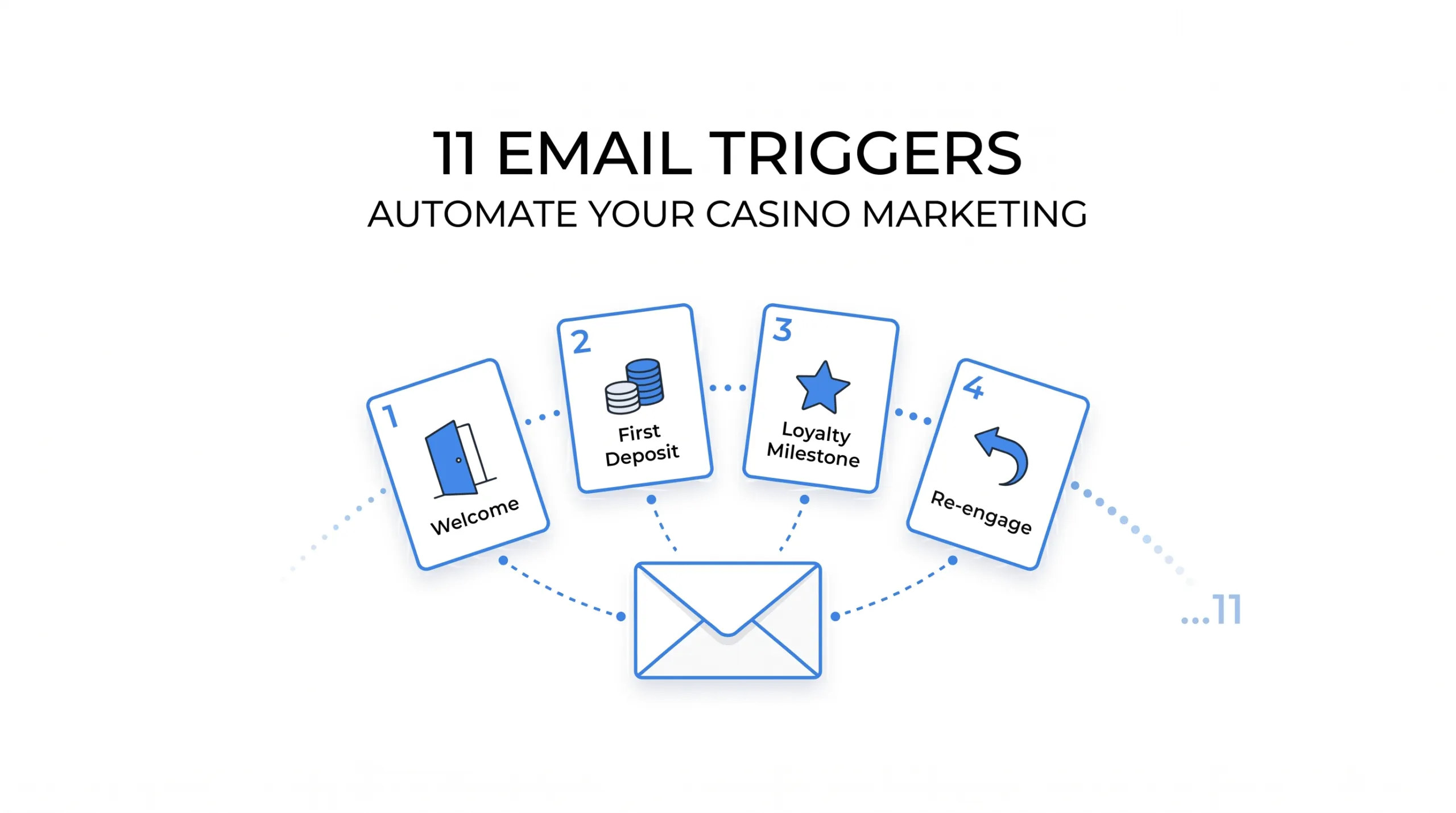
- The 11 casino email triggers cover the full player lifecycle: registration activation, FTD confirmation, deposit abandonment, second-deposit nudge, tiered inactivity, big win, loss recovery, bonus expiry, tier progress, cross-product, and KYC drop-off.
- Behavior-triggered emails consistently outperform broadcast campaigns on open rate, click-through, and downstream deposit conversion — the same player base, the same content, materially different revenue outcomes.
- Generic email platforms (Mailchimp, HubSpot, SendGrid) cannot run the full stack without custom event-data engineering — they lack real-time iGaming event ingestion, native behavioral segmentation, and gambling-content tolerance.
- Mature operators run 60–70% triggered email and 30–40% broadcast. Growth-stage operators usually start at the reverse ratio and shift over 6–12 months as the trigger stack matures.
Quick answer: How many email triggers should a casino have?
A complete iGaming email trigger stack covers 11 triggers across the full player lifecycle — from post-registration activation through KYC drop-off. Most growth-stage operators start with three foundational triggers (registration activation, FTD confirmation, deposit abandonment) and add the remaining eight in sequence over 3–6 months, prioritized by revenue impact and data complexity.
For most casino operators, email is still doing the same job it did five years ago: blasting promotions to a list. Open rates drop, churn keeps climbing, and the CRM team works harder for the same retention numbers.
The operators pulling ahead in 2026 have changed one thing — they stopped sending campaigns and started building triggers. Instead of choosing what to send each week, their email program reacts to player behavior in real time: a registration that didn’t convert, a deposit that stalled at the cashier, a sudden 7-day silence from a VIP, a near-miss on a tier upgrade.
This is the shift from broadcast email to behavior-triggered lifecycle automation. And in iGaming — where every player’s value is a moving target and the next deposit decides whether they stay or churn — it’s no longer optional.
This article covers the 11 email triggers every casino, sportsbook, or hybrid operator should have running in 2026: the segment each one targets, the workflow logic behind it, typical performance benchmarks, responsible gambling guardrails, what to measure, and how to prioritize implementation if you’re building this stack from scratch.
What is an email trigger in iGaming?
An email trigger in iGaming is an automated email that fires based on a specific player event or behavioral condition — registration, deposit, bet, inactivity, bonus expiry — rather than a manually scheduled date. The trigger executes in real time when a defined event matches the player’s eligibility filter, timing window, and frequency cap rules.
A trigger is defined by four components:
- A behavioral or status event (registration, deposit, login, bet, withdrawal request, inactivity timer)
- An eligibility filter (player segment, tier, jurisdiction, channel consent, RG status)
- A timing window (immediate, +30 minutes, +24 hours, +7 days)
- A frequency cap (max sends per player per week across all triggers)
When all conditions match, the email fires automatically. The CRM team builds the logic once; the system handles execution across thousands of players in parallel.
This is fundamentally different from a scheduled “Saturday newsletter.” Triggers respond to what the player just did — or didn’t do — which is why they consistently outperform broadcast sends across open rate, CTR, and downstream deposit metrics.
Why Mailchimp and HubSpot fail for casino email automation
Most operators start with Mailchimp, HubSpot, SendGrid, or another general-purpose email platform. The wall they hit is always the same:
- No native player event model. General CRMs are built around contacts, deals, and pipelines — not deposits, bets, bonuses, and game sessions. Every trigger needs custom engineering to translate iGaming events into CRM-readable formats.
- No real-time event ingestion. Lifecycle triggers need to fire within minutes of the event, not on the next nightly sync. Generic tools batch-process data, which kills the timing window that makes triggers work.
- Gambling content gets flagged or banned. Several mainstream email providers explicitly prohibit gambling content in their terms of service. Operators get suspended mid-campaign with no warning.
- No multi-currency, multi-brand, multi-jurisdiction logic. A global operator running across LATAM, Europe, and Asia needs triggers that respect localization, regulation, and brand context. Generic tools treat every user the same.
- No native behavior-based segmentation. Segmenting by “deposited in the last 7 days, played slots more than table games, currently tier 2” is trivial in an iGaming CRM and impossible in a generic email platform without a custom data warehouse layer.
The result: operators end up with broken triggers, manual list exports, and a CRM team spending more time on data plumbing than on retention strategy. The triggers below assume a CRM stack with native iGaming event support and real-time execution — the baseline for serious lifecycle work in 2026.
The 11 casino email triggers to automate in 2026
1. Post-registration activation trigger
Fires when: A player registers but has not made a first deposit within 24 hours.
Target segment: New registrants (D0–D7 since signup, no FTD).
Workflow logic: The first 48 hours after registration are the highest-conversion window for FTD. A single welcome email is not enough — the sequence should include three sends: an immediate welcome (T+0), a value reminder with the welcome bonus and game suggestions (T+24h), and a final activation push with social proof or a soft deadline (T+72h).
Why it works: Operators consistently see 60–75% of FTDs happen in the first 7 days after registration. Past that window, conversion drops sharply. Automating this sequence captures the players you would otherwise lose to inertia.
2. First deposit confirmation + onboarding trigger
Fires when: A player makes their first deposit.
Target segment: FTD players, Day 0 of their deposit lifecycle.
Workflow logic: Immediate confirmation email with the bonus status, wagering requirements explained in plain language, and 2–3 game recommendations based on what the player browsed pre-deposit. Follow up at T+48h with a “how to get the most out of your bonus” send.
Why it works: Confirmation emails have some of the highest open rates of any send — often 60%+. Using that attention to set expectations on bonus terms reduces support tickets, and the game suggestion increases the chance of a second session within 72 hours — the strongest behavioral predictor of D30 retention.
3. Deposit abandonment trigger
Fires when: A player initiates a deposit but fails to complete (cashier opened, amount entered, payment not finalized).
Target segment: All registered players who reached the cashier in the last 60 minutes without success.
Workflow logic: Send within 30–60 minutes. The email should be short, address common friction (payment method declined, KYC pending, currency mismatch), and offer a direct link back to the cashier. If the player has done this twice in a week, escalate to live chat or SMS instead of another email.
Why it works: Most deposit failures are technical or procedural — declined card, wrong currency, KYC block. Many players don’t retry without a nudge. Catching them in the 1-hour window before the intent fades typically recovers 15–25% of failed deposits.
4. Second deposit nudge (the D2–D7 window)
Fires when: A player has made an FTD but no second deposit within 3–7 days.
Target segment: FTD-only players, no SD, within the D2–D7 window.
Workflow logic: A reload bonus or matched-deposit offer timed to land 3 days after the FTD, then again at day 6 if no SD occurred. The offer should reference what the player actually played — slots reload for slot players, sports bonus for sportsbook bettors.
Why it works: The gap between first and second deposit is the single largest churn point in the player lifecycle. Players who make a second deposit within 7 days of their first are 3–5x more likely to still be active at D90. This trigger directly targets that conversion event.
5. Inactivity trigger (tiered re-engagement)
Fires when: A player has been inactive for a defined period (no login, no bet, no deposit).
Target segment: Stratified by value tier and inactivity window — 3-day inactive VIPs, 7-day inactive regulars, 14-day inactive casuals, 30-day dormant accounts.
Workflow logic: Different timing windows for different player values. A high-value player going silent for 72 hours is a churn signal worth acting on immediately; a casual player only triggers a re-engagement send at 14 days. The message should reference what the player used to play, not generic “we miss you” copy. After 30 days, switch to a stronger incentive — free spins, no-deposit bonus, or tournament invite.
Why it works: Generic 30-day “win-back” emails ignore the value asymmetry of an iGaming player base. A VIP at risk of churn is worth ten casual players, and response time should reflect that. Behavior-tiered inactivity triggers are one of the highest-ROI automations an operator can build. This is where strong behavior-based player segmentation becomes a direct revenue driver.
6. Big win celebration trigger
Fires when: A player wins above a threshold — defined as a multiple of stake (e.g., 50x) or an absolute amount.
Target segment: Players who have just hit a significant win in the last 24 hours, excluding those who have already initiated withdrawal.
Workflow logic: A celebratory email within 24 hours referencing the win, suggesting a continuation with a similar themed game, and optionally including a small bonus or free spins on a related title. Keep it light and positive — this is reinforcement, not a sales push.
Why it works: Big wins create a peak emotional moment. Players who re-engage within 48 hours of a major win are significantly more likely to make a follow-up deposit. The trigger captures the emotional momentum before it fades. Critical exclusion: never email a player who has already requested withdrawal of the win — that is an intent-to-leave signal, not an upsell moment.
7. Loss recovery / cashback trigger
Fires when: A player has a net loss above a defined threshold over a 24–72 hour window.
Target segment: Players with significant net losses in a recent session window, excluding self-excluded or responsible-gambling-flagged accounts.
Workflow logic: A cashback email or “second chance” bonus sent 24–48 hours after the loss event. Tone matters here — the email should feel like a benefit, not a reaction to gambling activity. Always check responsible gambling flags and self-exclusion status before sending.
Why it works: Players who lose heavily without any operator response often disappear — they associate the brand with the loss and don’t return. A well-timed, responsibly framed cashback offer keeps them in the relationship and is one of the most effective churn prevention tools in iGaming. This trigger must be governed by strict RG rules: never send to flagged accounts, never frame as encouragement to chase losses.
8. Bonus expiry reminder trigger
Fires when: A player has an active bonus that will expire within 48 hours, with unused balance or unmet wagering.
Target segment: Players with active bonuses approaching expiry.
Workflow logic: Two sends — one at 48 hours pre-expiry, one at 6 hours pre-expiry. Subject line should be specific about what is expiring and how much is at stake. Include a direct link to the relevant game or a short “how to use this bonus” reminder.
Why it works: A large share of issued bonuses go unused. Players forget, get distracted, or didn’t understand the wagering. Recovering 20–30% of those expiries through reminder emails is a near-zero-cost retention win — the bonus is already accounted for in the operator’s books.
9. Loyalty tier progress trigger
Fires when: A player crosses 70%, 85%, or 95% of the requirements for the next loyalty tier.
Target segment: Active players within reach of a tier upgrade.
Workflow logic: The trigger fires when a player is close enough that one more session realistically pushes them over. The email should reference the exact gap (e.g., “You’re 1,200 points from Gold”) and what they unlock at the next tier. Exclude players already at the top tier or inactive for the last 14 days.
Why it works: Tier progress emails generate measurable session frequency increases — players act on proximity to a reward. The trigger compounds with the loyalty program’s intrinsic motivation, turning a passive system into an active one.
10. Cross-product / cross-vertical trigger
Fires when: A player has only engaged with one product (casino only, no sportsbook activity, or vice versa) and meets a minimum activity threshold.
Target segment: Single-product active players.
Workflow logic: Introduce the other vertical with a specific offer — free bet for casino players, casino bonus for sports bettors — and an explanation of the value. Time the send to coincide with a relevant moment: a major sports event for the casino-to-sport trigger, a new game launch for sport-to-casino.
Why it works: Multi-product players have significantly higher LTV and lower churn than single-product players. The cross-sell trigger is the most efficient way to expand a player’s relationship with the operator. This works best as part of a broader lifecycle marketing automation program rather than as a standalone campaign.
11. KYC and verification drop-off trigger
Fires when: A player has started but not completed KYC verification, or has been flagged for additional documentation.
Target segment: Players with incomplete verification, especially those who have already deposited.
Workflow logic: A clear, instructional email explaining exactly what is missing and how to submit it. Avoid corporate or compliance-heavy language — most players don’t understand why they are being asked for documents. Follow up after 48 hours if no action, then again at 5 days. If the player has deposits stuck pending verification, prioritize this trigger above all others.
Why it works: Incomplete KYC is a silent killer of deposits and withdrawals. Many operators lose deposited players who got blocked at verification and never came back. A clear, friendly email sequence at this stage recovers a meaningful share of those accounts — and reduces support load.
Typical performance benchmarks per trigger
Triggered emails outperform broadcast on virtually every meaningful metric, but the size of the lift varies sharply by trigger type. The ranges below reflect typical operator implementations across mid-size casino and sportsbook brands — useful as planning anchors when building the business case for each trigger.
| Trigger | Typical impact range |
|---|---|
| Post-registration activation sequence | Captures 60–75% of total FTDs within first 7 days post-signup |
| FTD confirmation + onboarding | 55–65% open rate (2–3x promotional baseline) |
| Deposit abandonment | 15–25% of failed deposits recovered within the 60-minute window |
| Second deposit nudge (D2–D7) | 3–5x higher D90 retention for players who SD within 7 days of FTD |
| Tiered inactivity re-engagement | Highest-ROI single trigger; VIP recovery rates 2–4x casual segment |
| Big win celebration | Notable lift in 48-hour follow-up deposit rate among non-withdrawing players |
| Loss recovery / cashback | Among the most effective single triggers for short-window churn prevention |
| Bonus expiry reminder | 20–30% recovery of otherwise-unused bonuses |
| Tier progress (70% / 85% / 95%) | Measurable session frequency lift within 72 hours of send |
| Cross-product / cross-vertical | Multi-product players carry materially higher LTV than single-product equivalents |
| KYC verification drop-off | Meaningful recovery of stuck-deposit accounts and reduced support ticket volume |
These ranges depend heavily on player base composition, vertical mix, geo distribution, and the underlying CRM platform’s event-execution capability. They are planning anchors, not guaranteed outcomes — actual performance should be measured against a held-out control segment per trigger (see “What to measure” below).
Responsible gambling guardrails across all triggers
Every trigger in the stack must respect responsible gambling rules at the platform level — not as an afterthought layered on top. This means hard exclusions of self-excluded and RG-flagged accounts from all promotional triggers (loss recovery and big win are the highest-risk here, but all incentive-based sends apply); regional compliance flags that suppress triggers in jurisdictions with content or frequency restrictions (UK, several US states, Germany, Spain, the Netherlands among others); language that avoids loss-chasing framing or urgency around continued play; deposit-limit and reality-check awareness so that triggers don’t undermine the player’s own controls; and global frequency caps that prevent any player from receiving more than the regulatory or internal threshold across email, SMS, and push combined. Triggers that fail RG checks should fail silently — the player should not receive a fallback non-promotional send unless there is a compliance reason to communicate. Operators that bolt RG rules onto an existing trigger stack inevitably miss edge cases; building the rules into the eligibility filter for every trigger from day one is the only sustainable approach.
How to prioritize: a 4-stage rollout framework
Most operators don’t have the resources to launch 11 triggers at once. Implementation order matters more than coverage. The framework below sequences triggers by impact and effort.
| Stage | Triggers to launch | Why this stage |
|---|---|---|
| Stage 1 — Foundation | Post-registration activation, FTD confirmation, Deposit abandonment | Direct revenue impact, low data complexity, immediate ROI |
| Stage 2 — Retention | Second deposit nudge, Tiered inactivity, Bonus expiry | Targets the highest-churn lifecycle moments |
| Stage 3 — Behavioral | Big win, Loss recovery, Tier progress | Requires deeper event data and segmentation logic |
| Stage 4 — Expansion | Cross-product, KYC drop-off | Refinements once core lifecycle is stable |
Stage 1 alone typically lifts FTD-to-SD conversion by double digits in operators moving from broadcast email to triggered email. Stages 2 and 3 are where retention curves actually bend. Stage 4 is optimization, not foundation.
What to measure: trigger performance metrics
Open rate and CTR are surface metrics — they tell you whether the subject line and creative work, not whether the trigger drives revenue. Mature operators track triggers across four layers:
- Engagement metrics. Open rate, click-through rate, unsubscribe rate per trigger. Useful for creative iteration; not enough on their own to judge the trigger.
- Downstream conversion. The percentage of triggered emails that lead to the desired behavioral outcome — FTD for activation triggers, SD for second-deposit nudges, return-to-cashier for deposit abandonment, bet placed for inactivity recovery. This is the metric that justifies the trigger’s existence.
- Trigger health. Delivery rate, bounce rate, fail-to-send rate, and frequency-cap collisions — how often a player was eligible for a trigger but excluded because they had already hit the weekly cap. High collision rates signal the stack is over-triggering and needs cap recalibration; low collision rates with weak performance signal the opposite, that the stack is under-triggering and missing eligible players.
- Cohort lift. The most rigorous measure — compare players who received the trigger against a held-out control segment with the same eligibility but no send. The difference in downstream behavior is the trigger’s true contribution, separated from selection bias and lifecycle-stage effects.
The third and fourth layers usually require real-time analytics for iGaming with native event-level visibility and per-trigger attribution — granularity that generic email dashboards rarely provide. Without it, operators measure activity instead of impact.
Building the trigger stack
The triggers above only work if the CRM platform underneath them can handle iGaming-specific event data in real time, segment players by behavior natively, and execute sends without engineering involvement on every change.
Platforms like InTarget are built specifically for this — combining a native player event timeline, behavior-based segmentation, trigger-based marketing automation, and a visual campaign builder so a single CRM manager can deploy and adjust the full lifecycle stack without developer support. For operators outgrowing Mailchimp or HubSpot but not yet ready for enterprise platforms like Optimove or Fast Track, this is the operational layer where most of the lifecycle work happens. The same triggers extend across email, SMS, and push notifications, so a single behavioral event can drive coordinated multi-channel response without separate workflows.
The technical specifics aside, the principle is the same regardless of which iGaming CRM an operator runs: triggers replace broadcasts, behavior replaces calendars, and real-time event data replaces nightly batch exports.
Frequently asked questions
What’s the minimum email trigger stack a small operator should start with?
Three foundational triggers: post-registration activation, FTD confirmation, and deposit abandonment. These cover the highest-revenue lifecycle moments (signup-to-FTD and FTD recovery) and require the least complex event data. Most CRM teams can launch them in 1–2 weeks and use the performance baseline to justify adding the Stage 2 retention triggers next.
What is the difference between an email trigger and an email campaign?
A campaign is a manually scheduled send to a list — for example, Friday’s promo to all active players. A trigger is automated and fires based on a player event; the timing and recipient are determined by behavior, not the marketing calendar. Both have a role, but in iGaming, triggers should account for 60–70% of total email volume for retention to work.
Can these triggers run on Mailchimp or HubSpot?
Not natively. Generic email platforms don’t ingest iGaming events (deposits, bets, wins, sessions) in real time and don’t model players as behavioral entities. Operators typically need a dedicated iGaming CRM or marketing automation platform with native event support to run the full trigger stack. Some teams hack it with custom integrations, but maintenance becomes the bottleneck.
How often should I send these triggered emails to the same player?
Frequency caps matter more than per-trigger rules. A typical baseline is no more than 4–6 triggered emails per player per week across all triggers combined, with hard exclusions for VIPs (lower frequency, higher relevance) and self-excluded or RG-flagged accounts (zero promotional sends). Build the cap at the platform level, not per-trigger.
Do these triggers replace promotional email campaigns?
No — they complement them. Promotional campaigns drive seasonal offers, tournament launches, and one-off events. Triggers handle the always-on lifecycle work. The ratio shifts over time: most operators starting their automation journey are 90% broadcast / 10% triggered; mature operators tend to land around 30% broadcast / 70% triggered.
How long does it take to launch a full trigger stack?
With a platform built for iGaming and a CRM manager who knows the product, the Stage 1 triggers can typically launch in 1–2 weeks. The full 11-trigger stack — including segmentation, frequency caps, and testing — usually takes 6–10 weeks. The bottleneck is rarely the platform; it’s the data hygiene and segmentation logic upstream.