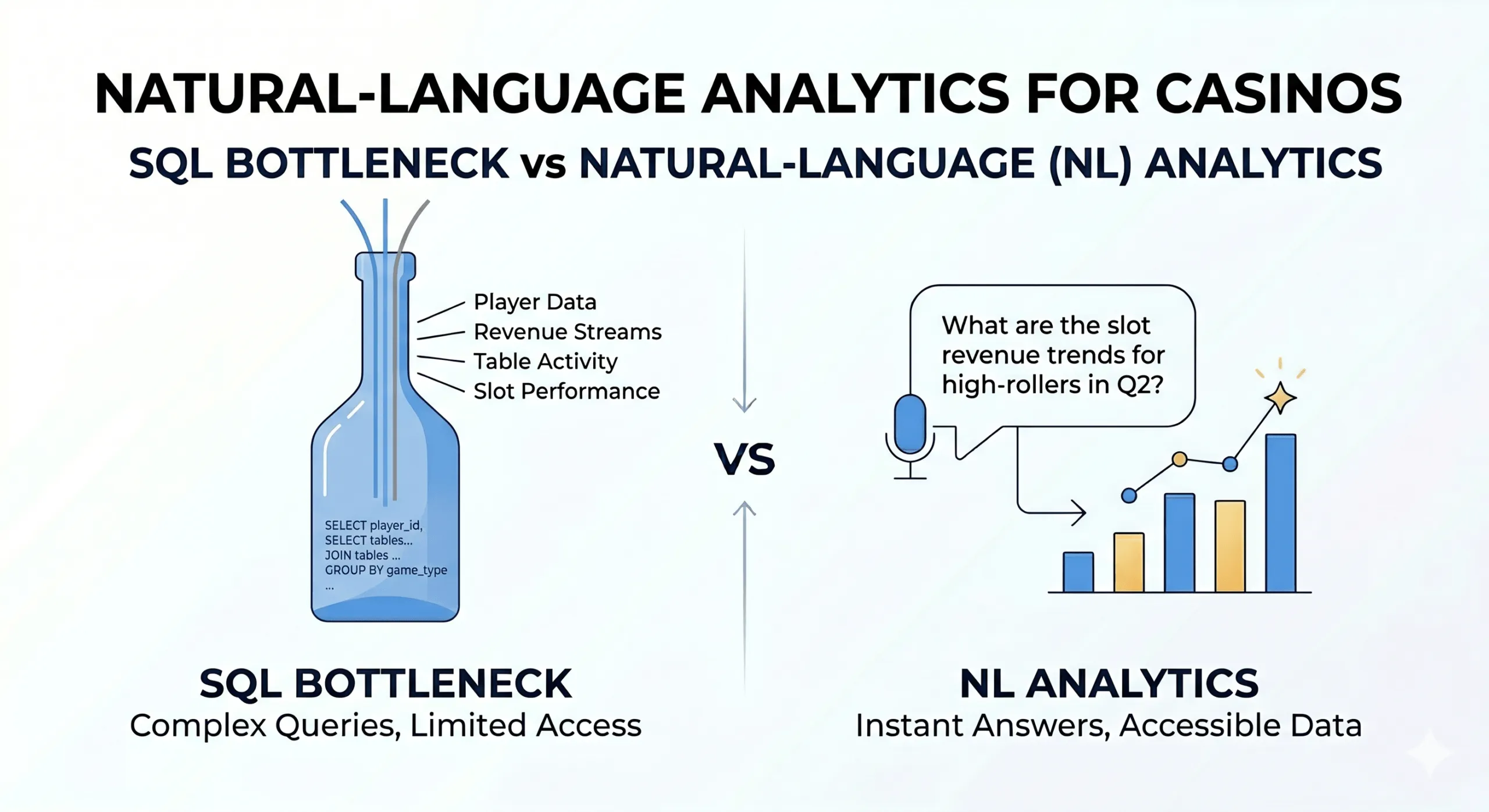
Every iGaming operator has the data. The deposits, the session logs, the campaign results, the segment sizes, the churn signals — it all exists somewhere in the stack. The problem was never that the data doesn’t exist. The problem is the queue between the CRM manager who has a question and the analyst who can answer it.
A retention manager spots a drop in second deposits on Tuesday afternoon. They need to know which cohort, which channel, which deposit band — and they need it before the weekend promo locks. So they file a request with the data team. The query comes back Thursday. By then the window has closed, the promo went out untargeted, and the insight is a post-mortem instead of a decision.
This is the SQL bottleneck, and it quietly throttles retention operations at almost every small-to-mid-size operator. Natural-language analytics is how the bottleneck gets removed.
Quick answer: Natural-language analytics lets a CRM manager ask questions about player data in plain English and get instant, structured answers from live data — no SQL, no analyst queue, no BI tool. It collapses the time between a retention question and a usable answer from days to seconds.
What is natural-language analytics in an iGaming CRM?
Natural-language analytics is an AI-powered interface that translates a question typed in everyday language into a query against the operator’s live player database, then returns a structured answer in seconds. Instead of writing SQL or building a dashboard, the CRM manager asks — “How many players made a first deposit last week?” — and the system interprets, retrieves, and answers directly from real player activity.
The distinction that matters: this is not a chatbot generating generic gambling advice. It is a data interface wired into the operator’s own CRM — the same deposits, segments, lifecycle stages, and campaign results that drive segmentation and automation. The numbers it returns are real, drawn from the live player base, not industry benchmarks or estimates.
Key takeaways
- The bottleneck in casino analytics is rarely missing data — it’s access. Most CRM managers can’t query data without technical help.
- Natural-language analytics removes the dependency on SQL skills, BI tool training, and the analyst queue.
- The real value is speed of iteration: the person running the campaign can answer their own questions in real time.
- It only delivers value when connected to live CRM data — disconnected “AI insights” tools recreate the context-switching problem they claim to solve.
Why generic BI tools fail iGaming retention teams
Enterprise BI platforms are powerful, but they were built for analysts, not retention operators. That mismatch creates three recurring failures for casino and sportsbook CRM teams.
They assume technical fluency. Tableau needs training. Looker needs data modeling. Even “self-service” BI assumes the user knows which table to query, which dimension to filter, and how to read a pivot chart. A CRM manager thinks in players, deposits, and lifecycle stages — not schemas and joins.
They answer yesterday’s questions. A dashboard answers the questions someone anticipated when they built it. But retention questions are ad-hoc by nature: Did the Monday free-spins push actually beat last Monday’s? Is the VIP segment growing or shrinking this month? The moment the question wasn’t pre-built into a report, the operator is back in the analyst queue.
They break the path from insight to action. Generic tools stop at the number. You get a chart, then you export a CSV, switch to your CRM, rebuild the segment, and launch the campaign. That context-switching is where insight dies — and it’s why analytics that live outside the CRM rarely change what operators actually do.
For a small CRM team — often a single manager running lifecycle campaigns — none of these tradeoffs are acceptable. When there’s no dedicated analyst, the CRM manager is the analyst, and they need answers at the speed of the campaign, not the speed of the queue.
The operator workflow: from question to campaign
The point of natural-language analytics isn’t the answer in isolation — it’s how quickly the answer becomes a retention action. Here’s how the loop actually runs for a CRM manager inside a connected platform.
1. Ask the operational question. “Show me players who deposited over €500 last month but haven’t logged in this week.” The system returns a filtered player list — not a generic report, an actual cohort.
2. Convert the answer into a segment. That list becomes a dynamic player segment without manually rebuilding the filter logic. The insight and the targeting criteria are the same object.
3. Attach a lifecycle flow. Check whether the at-risk segment already has an active lifecycle automation running. If it doesn’t, build a re-engagement flow — a reactivation email, a follow-up SMS, a personalized bonus offer triggered by continued inactivity.
4. Validate against revenue. After the campaign runs, ask the next question: “Did the reactivation email drive more deposits than last month’s version?” Here the natural-language layer reads from conversion attribution data — opens, clicks, and actual deposits per message — so the decision to keep, adjust, or kill the campaign is grounded in revenue, not open rates.
Because each step works on the same live data layer, there’s no translation gap between understanding and acting. The manager doesn’t carry an insight from a BI tool into a separate CRM. It all happens in one interface, which is what makes the iteration fast enough to matter.
This is the same logic that powers effective trigger marketing: behavior in, response out, with no engineering ticket in between.
What CRM managers actually ask
The questions that drive retention are practical and operational — and almost none of them are standing dashboard reports. A few representative examples:
- “How many first-time depositors did we have last week, broken down by day?”
- “What’s the average deposit for sports bettors versus casino players this month?”
- “What percentage of the January registration cohort is still active?”
- “Which reactivation email had the highest deposit conversion?”
- “Which game category drives the highest deposit frequency among new players?”
- “Which player segment has the highest churn risk right now?”
Each of these would traditionally require a SQL query or an analyst request. With a natural-language layer connected to the iGaming CRM, the person who needs the answer gets it directly — and can immediately ask the follow-up, which is usually where the real insight lives.
Traditional BI workflow vs. natural-language analytics
| Aspect | Traditional BI / analyst workflow | Natural-language analytics (in-CRM) |
|---|---|---|
| Who asks | CRM manager files a request to the data team | CRM manager asks directly in plain English |
| Time to answer | Hours to days (analyst queue) | Seconds — real-time query execution |
| Skills required | SQL, BI proficiency, or analyst dependency | None — natural language input |
| Data freshness | Last export or scheduled refresh | Live CRM data — deposits, sessions, campaigns now |
| Follow-up questions | New request, back in the queue | Instant — ask the next one immediately |
| Path to action | Export → switch tool → rebuild segment → launch | Insight and action in the same interface |
| Cost | BI license + analyst hours | Built into the CRM — no extra tool or headcount |
Where natural-language analytics fits in the iGaming retention stack
Natural-language analytics isn’t a replacement for purpose-built iGaming analytics — registration cohort metrics, transaction breakdowns, GGR and RTP reporting still matter for structured, recurring measurement. The natural-language layer sits on top of that: it handles the ad-hoc, “I need to know this right now” questions that dashboards were never designed to answer.
This is the gap platforms like InTarget address with the AI Data Helper — a natural-language interface built directly into the CRM, querying the same live player data that powers segmentation and automation. For growing operators with small CRM teams, that integration is the point: it lets a single CRM manager investigate player behavior, validate campaign performance, and act on the answer without a SQL query, a BI license, or a wait in the analyst queue. Because the platform is iGaming-native and typically launches within about a week, the analytics layer speaks in the metrics operators actually use — FTDs, deposit frequency, lifecycle stage — rather than generic database fields.
If you’re moving off generic tools or evaluating where CRM should sit in your stack, the broader tradeoffs are covered in the complete iGaming CRM operator guide and the iGaming CRM platform decision guide.
What about player-data security?
It’s a fair objection, and the first one most operators raise: if an AI layer can query live player data, what stops it from exposing it? The answer is that a well-designed natural-language layer doesn’t create a new data store or a new access path — it queries the same player database under the same permissions that already govern the CRM. It reads what the logged-in user is already authorized to see, and it shouldn’t move player-level PII outside the platform to answer a question. The right mental model isn’t “a chatbot with access to your database”; it’s a query interface that respects existing roles, jurisdictional rules, and data-handling controls. For regulated iGaming operators, that distinction — querying inside the governed CRM rather than piping data to an external BI tool or third-party model — is exactly what keeps natural-language analytics compatible with player-data privacy obligations.
Frequently asked questions
What is the SQL bottleneck in casino analytics?
It’s the gap between a CRM manager who has a question and the technical resource needed to answer it. The data exists, but accessing it requires SQL skills, a BI tool, or an analyst — so operational questions sit in a queue for hours or days, often past the point where the answer is useful.
Does natural-language analytics replace my analyst or BI tool?
For ad-hoc retention questions, largely yes — the CRM manager can answer their own questions in real time. For deep statistical modeling or complex multi-source reporting, dedicated analysts and BI tools still have a role. The natural-language layer removes the everyday dependency, not the specialist function.
Is the data real or estimated?
It should query your live player data directly. A genuine natural-language analytics layer returns real numbers from your actual player base — deposits, segments, campaign results — not industry benchmarks or generic estimates. If a tool can’t connect to your live CRM data, it can’t answer operational questions accurately.
Do CRM managers need technical skills to use it?
No. The interface is designed for retention operators without technical backgrounds. You type a question the way you’d ask a colleague; the system interprets it and queries the data. If it needs clarification, it asks a follow-up rather than returning an error.
How is this different from a dashboard?
A dashboard answers pre-defined questions — the ones someone anticipated when building the report. Natural-language analytics answers any question on demand, including ones never built into a dashboard. It’s ad-hoc, conversational, and works against live data in seconds.
Why does it matter that it’s built into the CRM?
Because the value isn’t the answer — it’s the action that follows. When analytics lives inside the CRM, an insight (“these VIPs are going dark”) becomes a segment and a campaign without exporting, switching tools, or rebuilding logic. Disconnected analytics tools recreate the context-switching problem they claim to solve.