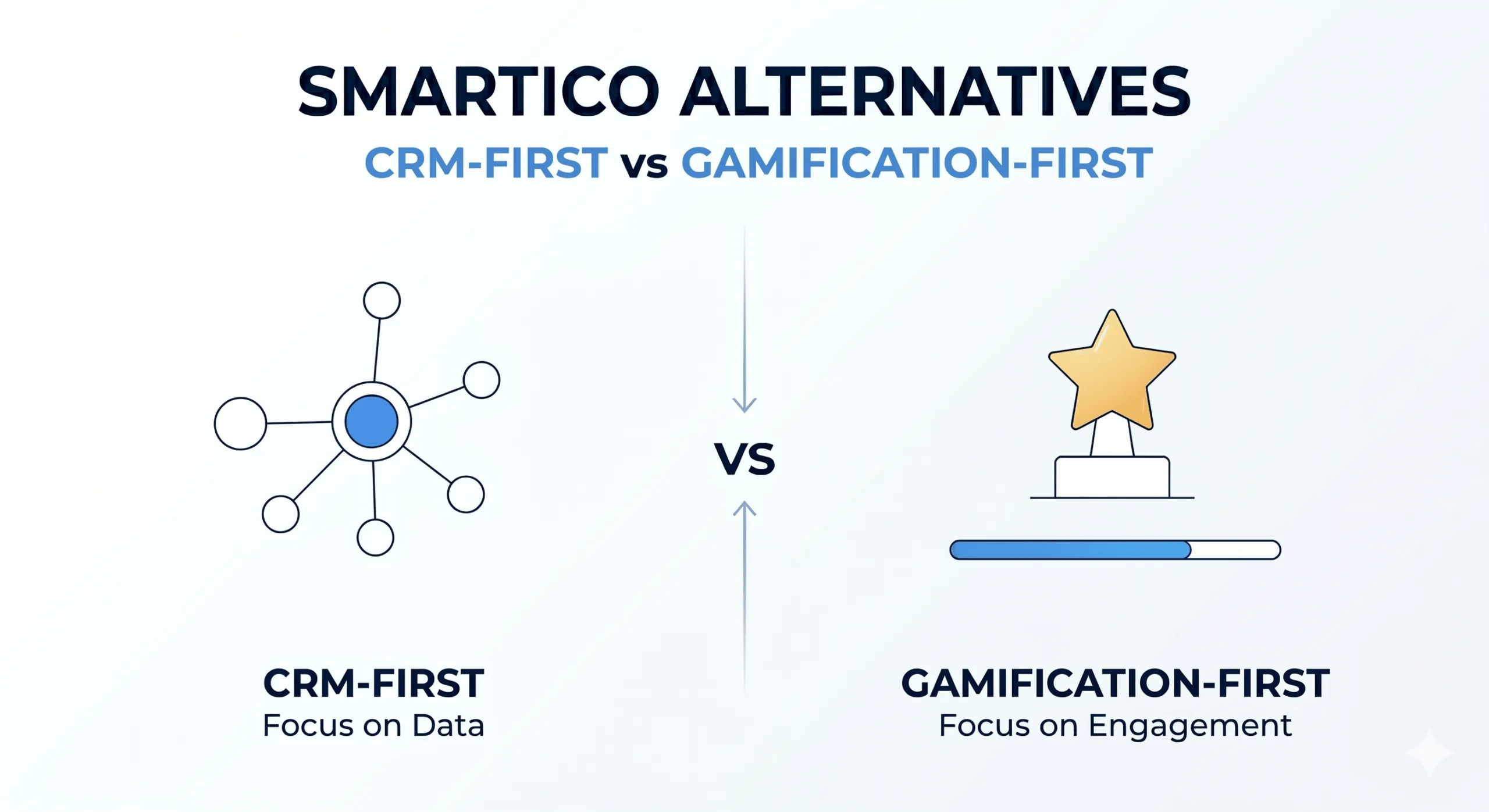
You don’t pick a player retention software platform. You pick a center of gravity.
That’s the decision most operators get wrong when they shortlist Smartico. They evaluate it as “an iGaming CRM platform with extra features,” compare feature checklists against three other vendors, and miss the structural choice underneath: a gamification-first platform organizes your entire retention operation around mechanics — missions, wheels, tournaments, levels, loyalty shops — and treats segmentation and lifecycle messaging as the supporting cast. A CRM-first platform inverts that. Behavioral segmentation and lifecycle automation are the engine; everything else plugs into it.
Both can be the right answer. But they are not interchangeable, and operators who choose the wrong center of gravity end up paying for a layer they barely use while underinvesting in the one that actually moves their numbers.
This guide is for operators evaluating Smartico alternatives who want to make that choice deliberately — not by feature count, but by what their retention actually runs on.
What “gamification-first” vs “CRM-first” actually means
Smartico built its reputation by fusing gamification mechanics directly into the CRM layer — missions, levels, free-to-play games, jackpots, and loyalty mechanics treated as first-class, productized systems rather than add-ons. Founded in 2019, the company built a CRM system covering automation, gamification, F2P mini-games, bonus engines, jackpots and risk modelling (SBC News). That’s a genuine category — and for a specific kind of operator, it’s the correct one.
Here’s the distinction in plain terms:
Gamification-first retention assumes engagement is the primary lever. The theory: players churn because they’re bored, so you keep them playing with mechanics — a daily mission, a wheel spin, a leaderboard, a level to climb. The CRM exists to feed and trigger those mechanics.
CRM-first retention assumes behavior is the primary lever. The theory: players churn for identifiable, segmentable reasons — a deposit that didn’t repeat, a session pattern that’s decaying, a bonus that didn’t convert — and the job is to detect those signals and respond with the right message on the right channel at the right moment. Mechanics, where used, are one response among many.
The question that resolves which camp you’re in isn’t “do I want gamification?” Almost everyone says yes. The real question is: if you stripped the gamification mechanics out, would your retention program still function — or is it the whole program?
Why generic tools fail at this decision entirely
Before comparing iGaming-native platforms, it’s worth naming why operators land here in the first place. Tools like Mailchimp, HubSpot, and Salesforce Marketing Cloud weren’t built for the iGaming player object. They have no native concept of a first-time deposit, a bonus wallet, wagering progress, GGR, or a multi-currency real-plus-bonus balance. You can force these in with custom fields and integrations, but you end up maintaining a fragile translation layer between how your platform thinks about players and how your CRM thinks about contacts.
That mismatch is why operators migrate to a purpose-built casino CRM — and it’s also why the gamification-vs-CRM-core question gets buried. When you’re escaping a generic tool, anything purpose-built for iGaming feels like an upgrade, and you don’t slow down to ask which kind of purpose-built platform fits your operation. That’s the mistake this guide is trying to prevent.
The operator workflow that exposes the difference
Walk through a single, common retention scenario and the two models diverge immediately.
Scenario: A previously active slots player — three deposits in their first two weeks — hasn’t logged in for nine days. Their deposit cadence has clearly broken.
A gamification-first response: enroll them in a re-engagement mission, drop a free-spin reward into their loyalty shop, surface a “you’re 80% to the next level” nudge. The bet is that a mechanic pulls them back.
A CRM-first response starts earlier and asks different questions. What segment does this player actually belong to — value tier, game preference, deposit method, responsible-gambling flags? Why did the cadence break: a withdrawal that signaled cash-out intent, a losing streak, or simply the end of a welcome-bonus runway? The lifecycle flow branches on those answers: a soft win-back email for the casual, a personalized bonus for the value player who lost a streak, and an explicit exclusion for anyone carrying a self-exclusion or cool-off flag — because firing a re-engagement campaign at a player who set a limit is both a compliance failure and a trust failure.
Notice what’s load-bearing in the CRM-first version: segmentation precision, behavioral triggers, branching logic, channel coordination, and exclusion rules. The mechanic — if you use one — is the last step, not the first.
This is the gap competitors consistently miss in their content and, often, their tooling: the segmentation rationale and the exclusion logic, not the reward. Operators whose real lever is behavioral targeting need that engine to be the core of the platform, not a feeder for the mission system.
The CRM-first capability stack
If you decide your retention runs on behavior rather than mechanics, here’s the capability stack that actually has to be strong — and it’s worth checking each one against any Smartico alternative on your list:
- A real player timeline. Every interaction — first spin to last withdrawal, transactions, bonus events, communications across channels — in one chronological view. Without this, segmentation is guesswork.
- Behavior-based segmentation. The ability to build segments from any demographic or event data — deposit cadence, game type, value tier, session decay — not just static lists. This is the foundation everything else stands on; InTarget’s behavior-based player segmentation is built around exactly this, letting a CRM manager combine conditions on deposits, withdrawals, casino and sportsbook activity, balances and message engagement over any period: lifetime, the last N days, or a fixed date range.
- Real-time behavioral triggers. Reacting to registration, login, deposit, game-play, and webhook events as they happen, with period-based conditions (within last N days, since entering a campaign, lifetime). InTarget exposes 50+ event triggers for this kind of precise trigger marketing.
- Churn prediction you can act on. A risk score is only useful if it lands in the segment builder. InTarget scores every player with a deposit in the last 60 days once a day: the probability of no deposit in the next 7, 14 and 30 days, a value segment from Whale to Micro, and a state measured against the player’s own deposit rhythm (Active, Cooling, At Risk, Dormant, Dead). “High value and At Risk” becomes a list, not a spreadsheet exercise.
- Lifecycle automation with branching. Visual, no-code flows with True/False splits, A/B tests (50/50 or with a control group), and wait-until/wait-window conditions — so a single re-engagement campaign can branch by value tier and channel. See lifecycle marketing automation for iGaming.
- Omnichannel execution. Email, SMS, push, on-site messages, Facebook Messenger and Instagram Direct coordinated from one place, so the same player doesn’t get cross-fired across channels. Email and SMS can wait for a delivery window in the player’s time zone instead of landing at 3 a.m.
- Exclusions that don’t depend on memory. In InTarget, players flagged as self-excluded or blocked in the operator’s data are skipped by every send automatically, as are unsubscribed contacts and email addresses that bounced or complained. That is the baseline the scenario above relies on.
- Conversion attribution. Per-step, per-channel revenue tracking so you know which messages drove deposits — the difference between a retention program you can defend with numbers and one you run on faith. InTarget’s revenue attribution tags every link down to the campaign step and credits the deposit to the last click.
The actual Smartico competitors, mapped to the framework
If you’re shortlisting Smartico alternatives, here’s how the main platforms in the category fall along the gamification-first / CRM-first axis. The point isn’t to rank them — it’s to show that “iGaming CRM” hides several genuinely different products, and the right one depends on your center of gravity.
| Platform | Where it leans | Best fit |
|---|---|---|
| Optimove | CRM-first, analytics-heavy | Strong predictive analytics and segmentation; geared to enterprise operators with the budget and team to run it (EngageHut) |
| Fast Track | CRM-first, real-time journeys | Real-time triggers for multi-brand, multi-market operators, with sportsbook logic such as settlement tracking and odds-triggered promotions; steep learning curve, and Optimove still leads on AI maturity (EngageHut) |
| Solitics | Real-time CDP + gamification | Real-time data unification with an API-first architecture, plus native missions; suits operators who already own execution tools and need a data layer (Xtremepush blog) |
| Xtremepush | CDP + gamification, mobile-first | Real-time CDP with strong push/in-app and gamification; more flexible than iGaming-only tools for marketing beyond gaming (EngageHut) |
| Symplify | CRM-first, channel breadth | Ten channels, easy to learn without a large CRM team, strong in Nordic/European markets; lighter in UK/US regulated markets (Xtremepush blog) |
| Enteractive | Human outreach layer | Routes high-value lapse risks to trained agents for compliant personal outreach (iGaming CRM Blog); a complement to a CRM, not a replacement for one |
| InTarget | CRM-first, lean teams | Small-to-mid-size operators running 1–3 CRM managers who need segmentation, daily churn scores, lifecycle automation, and per-step attribution from €750/month |
Two things stand out. First, several “alternatives” — Solitics and Xtremepush especially — share Smartico’s instinct to bake gamification into the core, so switching to them doesn’t change your center of gravity, it just changes vendors. Second, Enteractive isn’t really in either camp; it’s a human-agent layer that sits on top of whichever CRM you choose. If your reason for leaving Smartico is that gamification isn’t your real lever, the genuinely CRM-first options are the ones to weigh — and if you’re cross-shopping the enterprise end, our Optimove alternatives breakdown and Fast Track alternatives guide go deeper on those two specifically.
Comparison framework: which center of gravity fits you
Rather than rank platforms, evaluate against your own operation. This framework decides the question for most operators:
| Decision factor | Gamification-first fits if… | CRM-first fits if… |
|---|---|---|
| Primary churn cause | Players disengage from boredom; engagement loops keep them active | Players churn for segmentable behavioral reasons (cadence, value, intent) |
| Core retention lever | Missions, wheels, tournaments, loyalty mechanics | Segmentation + lifecycle messaging + attribution |
| Team structure | Strong product-CRM collaboration; mechanics need design/product input | Small CRM team (1–3) running campaigns independently |
| Bonus economics | Bonus fatigue is real; mechanics replace cash incentives | You need to target and attribute every bonus precisely |
| Day-30+ behavior | VIP depth and gamified loyalty are the main challenge | Reactivation and lifecycle timing are the main challenge |
| Operational complexity tolerance | Willing to run a productized gamification system | Want fast launch, no developers, lean operation |
If your honest answers cluster in the right column, a gamification-first platform is asking you to buy and operate a layer that isn’t your primary lever — and a CRM-first lifecycle marketing platform will fit your operation better.
Cost and migration: the contrast that matters for growth-stage operators
For smaller operators, the gamification-vs-CRM question collides with a budget question. Most enterprise-tier platforms in this category price on per-MAU (monthly active user) models, where your cost scales with your player base and the heavier platforms often carry implementation timelines measured in months. That’s defensible at enterprise scale; it’s punishing for a growth-stage operator whose margins are still thin.
The contrast worth putting in front of a cost-conscious buyer:
- Enterprise per-MAU model: cost rises as you grow; multi-week to multi-month onboarding; often a dedicated team assumed.
- InTarget’s model: pricing from €750/month, typically launched in about a week with free data migration, operable by a single CRM manager.
Treat any specific competitor pricing as something to confirm directly — published per-MAU figures vary by contract and aren’t reliably disclosed. The structural point holds regardless: a predictable cost from €750/month and a one-week launch change the math for an operator who wants advanced retention without an enterprise commitment.
A note on the Smartico–Optimove acquisition
One factor changed in 2026 that belongs in any current evaluation. In April 2026, Optimove signed an agreement to acquire Smartico, with both companies stated to continue operating as fully independent businesses, each keeping its own brand, team, product strategy, and roadmap, and Smartico’s founders retaining decision-making authority. The announcement said nothing changes for Smartico’s clients: the same team, product, pricing and service model (GlobeNewswire, HIPTHER).
For operators, the practical read is measured: the acquisition changes less about immediate functionality and more about vendor risk and roadmap confidence. It doesn’t change the core CRM-first vs gamification-first question — but if long-term roadmap independence matters to your selection, it’s a factor worth weighing rather than ignoring (ContentGrip).
Where InTarget fits
InTarget sits firmly in the CRM-first camp by design. It’s built so the behavioral engine — player timeline, segmentation, daily churn prediction, real-time triggers, lifecycle automation, omnichannel messaging, and conversion attribution — is the core, with the platform aimed squarely at small-to-mid-size operators (roughly 500 to 150K monthly players) running lean CRM teams.
That positioning is deliberate: a single CRM manager can operate sophisticated lifecycle campaigns without developers, the platform typically launches in about a week with free data migration, and pricing starts from €750/month rather than enterprise per-MAU models. For an operator whose real lever is segmentation and lifecycle timing — not missions and wheels — that’s the center of gravity that matches the work.
InTarget doesn’t lead with gamification mechanics, and that’s the point. Rewards still have a place: a campaign step can send a personal bonus link with the amount or percentage, wager, free spins, minimum deposit and expiry built in, triggered and attributed like any other message. If your retention program would still function with the mechanics stripped out, a purpose-built iGaming CRM is the more honest fit than a platform organized around a layer you’d use sparingly.
Frequently asked questions
Is Smartico a good iGaming CRM?
Yes — for the right operator. Smartico is a genuinely strong platform for teams whose primary retention lever is gamification: missions, levels, F2P games, tournaments, and loyalty mechanics fused into the CRM. It’s less suited to operators whose retention runs on behavioral segmentation and lifecycle timing, where the gamification layer adds cost and complexity without matching the core need.
Who are the main Smartico competitors?
The closest alternatives in the iGaming CRM category include Optimove, Fast Track, Solitics, Xtremepush, InTarget and Symplify, plus complementary tools like Enteractive for human VIP outreach. They split along a key line: some (Solitics, Xtremepush) share Smartico’s gamification-in-the-core approach, while others (Optimove, Fast Track, Symplify, InTarget) lean CRM-first. The right choice depends on whether your retention runs on mechanics or on behavioral segmentation.
What’s the difference between gamification-first and CRM-first retention?
Gamification-first platforms organize retention around engagement mechanics and treat segmentation and messaging as supporting systems. CRM-first platforms make behavioral segmentation and lifecycle automation the engine, with mechanics as one possible response. The deciding question is whether your program would still function with the mechanics removed.
Did the Optimove acquisition change Smartico’s product?
According to the April 2026 announcements, Smartico continues to operate independently with its own brand, team, and roadmap, and reporting indicated no immediate change to pricing or product. The acquisition is more relevant to long-term vendor and roadmap considerations than to current functionality.
What’s a good Smartico alternative for a small CRM team?
Operators running lean teams (1–3 CRM managers) who need behavioral segmentation, lifecycle automation, and attribution — rather than a productized gamification system — should evaluate CRM-first, iGaming-native platforms like InTarget, which is built to be operated without developers and to launch quickly.
Do I have to give up gamification entirely if I choose CRM-first?
No. CRM-first means mechanics aren’t the organizing principle of your retention program — not that you can’t use rewards, bonuses, or incentives. The difference is that those are triggered by behavioral logic and attributed like any other campaign, rather than being the system everything else feeds.