

Player activity tracking is the key to improving retention and boosting revenue in online casinos and sportsbooks. Instead of relying on generic promotions, tracking metrics like session frequency, deposit habits, and game preferences helps operators understand their players better. This data enables personalized marketing, fraud detection, compliance, and responsible gaming efforts.
Key Takeaways:
- Metrics to Watch: Daily Active Users (DAU), Monthly Active Users (MAU), and Recency, Frequency, Monetary (RFM) analysis help identify engaged players and churn risks.
- Retention Focus: Retaining players is 5–7x cheaper than acquiring new ones. A 5% retention increase can lead to 25–95% profit growth.
- Technology Tools: Platforms like InTarget simplify tracking with AI-driven insights, real-time segmentation, and automation for small to mid-sized operators.
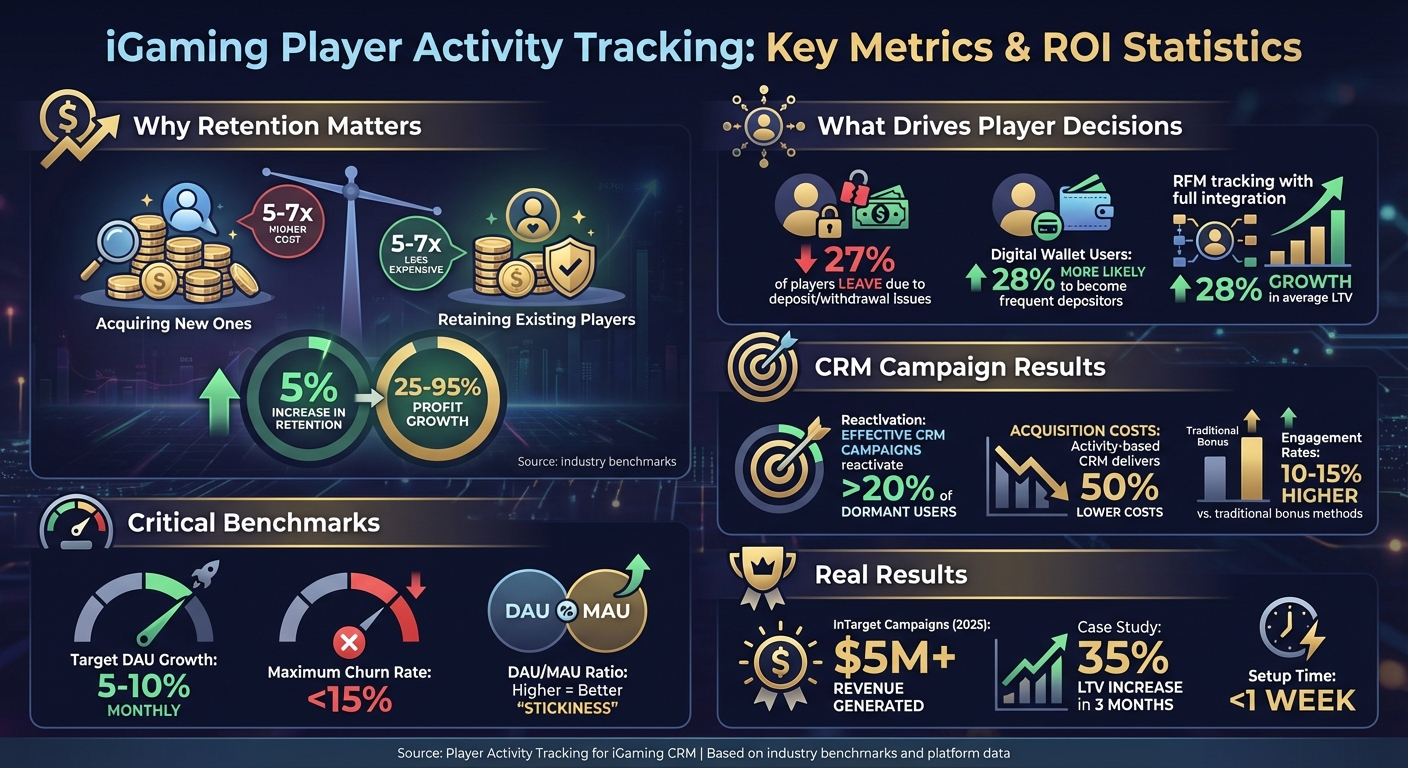
Key Player Activity Metrics and ROI Statistics for iGaming CRM
Key Metrics for Tracking Player Activity
Focusing on the right metrics can make the difference between sustainable growth and wasted marketing efforts. These metrics help identify engaged players, highlight churn risks, and uncover revenue trends.
Daily Active Users (DAU), Monthly Active Users (MAU), and Session Patterns
Daily Active Users (DAU) tracks the number of unique players engaging with your platform each day – whether they log in, place a bet, or make a deposit. Monthly Active Users (MAU) measures similar engagement over a 30-day period. By analyzing the DAU/MAU ratio (often called the "stickiness ratio"), you can gauge player engagement. A high ratio reflects strong player loyalty, while a low ratio might signal churn risks.
Aiming for 5%–10% monthly DAU growth while keeping churn below 15% is a healthy benchmark. Additionally, tracking session duration and frequency can help differentiate between players who are deeply engaged and those who only log in briefly.
"Active customers give every other KPI its meaning… actives aren’t just a ‘vanity metric’ – they are the denominator that reveals the health of your revenue." – Gamblitude
Overlaying active user data with Net Gaming Revenue (NGR) is essential. If revenue increases without a corresponding rise in active players, it could mean your platform is overly reliant on a small group of high-value users – a risky situation that could lead to instability if those users leave.
These metrics provide a foundation for segmenting players through RFM analysis.
Recency, Frequency, Monetary (RFM) Analysis
RFM analysis categorizes players based on how recently they’ve been active, how often they engage, and how much they spend. For example, a VIP player might have been active yesterday, logged 15+ sessions in a month, and deposited over $1,000. On the other hand, a player who hasn’t logged in for 35 days, plays fewer than five sessions monthly, and deposits less than $100 could either be new or at risk of churning.
This segmentation enables precise targeting. For instance, if a player shows high activity but low spending, a deposit bonus might encourage them to invest more. Meanwhile, a high spender with declining activity could benefit from a re-engagement offer. Platforms using RFM tracking with full integration have reported 28% growth in average LTV, while effective CRM campaigns can reactivate over 20% of dormant users.
Breaking players into these segments also supports deeper analysis of deposit patterns and lifetime value.
Deposit Patterns and Lifetime Value (LTV)
Deposit frequency is a strong indicator of player confidence and loyalty. A small group of high-value depositors often drives the majority of profits, so identifying and retaining them is critical.
It’s worth noting that retaining an existing player costs five to seven times less than acquiring a new one. Even a 5% increase in retention can lead to profit boosts ranging from 25% to 95%. Monitoring Bonus ROI ensures that promotional spending generates more revenue than it costs. If the ROI falls below 1.0, it means promotions are subsidizing gameplay rather than creating value. Additionally, 27% of players cite deposit and withdrawal issues as their main reason for leaving a platform.
"Players don’t see payments as admin – they see them as part of the game experience. Any break in trust at the transaction layer is a deal-breaker." – Joshua Rawlings, Casino.online
Interestingly, players using digital wallets are 28% more likely to become frequent depositors, especially when these payment methods are paired with cashback or loyalty rewards. By segmenting LTV based on acquisition channels and game preferences, operators can pinpoint the most reliable revenue streams and focus their resources effectively.
Technologies and Methods for Player Activity Tracking
Tracking player activity accurately relies on a mix of client-side and server-side technologies working together. On the client side, cookies and tracking pixels capture page views and clicks. Meanwhile, Player IDs connect all key activities – like deposits, game sessions, spin counts, and win totals – to specific loyalty accounts, creating a detailed timeline from login to withdrawal.
Event-based tools like Google Analytics 4 are designed to follow the entire player journey across websites and mobile apps. For operators managing multiple brands, platforms such as Voluum Tracker provide comprehensive tracking across hundreds of domains. However, client-side tracking can face challenges in regulated markets. To address this, Server-to-Server (S2S) tracking steps in, sending data directly between servers. This method ensures greater accuracy, particularly for financial transactions, while also offering better privacy and control over data.
For operators prioritizing privacy, tools like Matomo grant full data ownership while maintaining GDPR compliance. Behavioral analytics platforms like Fullstory can also be invaluable, identifying friction points – such as repeated form errors – so that user experience issues can be resolved quickly.
Real-time CRM systems take these tracking technologies a step further by integrating multiple data streams into actionable insights. For example, InTarget consolidates data from game servers, transaction logs, and communication tools into a single dashboard. This unified view provides operators with a complete picture of each player. Dynamic segmentation is another standout feature, allowing player categories to update instantly based on live behavior. One example: a casual player making a large deposit is automatically upgraded to VIP status. In 2025, campaigns tracked through real-time conversion attribution on the InTarget platform generated over $5 million in revenue.
"The ROI tracking alone pays for itself. We finally know which campaigns drive deposits and which don’t." – Daniel V, Casino Manager
To maximize campaign performance, operators should use automatic UTM tagging on all campaign links – whether through email, SMS, or push notifications. This approach pinpoints which channels drive deposits, enabling per-step attribution. By identifying the touchpoints that generate the most revenue, operators can fine-tune campaigns for optimal results.
Using CRM Platforms for Player Activity Insights
Unified Event Tracking and Attribution Models
Modern CRM platforms bring all player data into one place, creating a centralized hub for insights. Everything from login times and bet amounts to deposit transactions and game preferences is compiled into a single dashboard. This unified view makes it easier to track a player’s journey across all touchpoints.
Attribution models play a key role in identifying which marketing efforts drive revenue. For example:
- First-click attribution focuses on the initial interaction, like a promotional email that led to signup.
- Last-click attribution credits the final touchpoint before a deposit, such as a push notification.
- Multi-touch attribution spreads credit across all interactions. Imagine a player receives an email, an SMS reminder, and a push notification before finally making a deposit – this model evaluates the combined impact of these efforts.
Platforms like Salesforce Marketing Cloud use these models to analyze cross-channel campaigns, helping you see which combinations of email, SMS, and push notifications lead to the highest conversions.
To set up cross-platform tracking, campaign links need UTM parameters. These tags allow you to trace revenue back to specific messages, channels, or steps in your campaign. For instance, you can compare whether SMS outperforms email in driving deposits from high-value players or whether push notifications are better at re-engaging inactive accounts. Behavioral data – like session frequency, failed logins, or abandoned deposits – can reveal patterns that either increase engagement or lead to churn.
These advanced attribution models are foundational for CRM platforms and pave the way for solutions tailored to smaller operators, like InTarget, which simplify these complex tracking systems.
Using InTarget for Small to Mid-Sized Operators
InTarget is designed specifically for small and mid-sized online casinos and sportsbooks, offering enterprise-level tracking without the usual complexity. Unlike larger platforms that can take months to implement, InTarget integrates quickly with most iGaming systems, making it an accessible option for smaller teams.
The platform’s AI assistant is a standout feature for operators without dedicated data analysts. Marketing managers can ask straightforward questions like, “Which players haven’t deposited in the last 10 days?” or “How did last week’s cashback campaign perform?” The assistant provides immediate, data-driven answers, breaking down technical barriers that often limit smaller operators from fully utilizing their data.
InTarget’s dashboard is built for simplicity, making it easy to visualize key metrics like Recency, Frequency, and Monetary value (RFM) alongside event data. Non-technical users can quickly interpret these insights and take action. The platform also supports multi-touch attribution, tracking how combinations of email, SMS, and push notifications lead to deposits. Additionally, its dynamic segmentation feature updates player statuses in real time, enabling instant responses to changes in behavior.
This streamlined, user-friendly approach ensures that even smaller operators can leverage data effectively, turning player insights into actionable strategies.
Best Practices for Retention Using Player Activity Data
Triggered Campaigns and Personalized Messaging
Triggered campaigns rely on real-time behavioral data to create timely and personalized engagement. For example, if a player hasn’t logged in for seven days, an automatic reactivation bonus tailored to their favorite games – be it slots, sports betting, or live dealer tables – can be sent. This strategy works because it aligns with the player’s individual preferences rather than offering a generic promotion.
Segmentation plays a key role here. Using RFM (Recency, Frequency, Monetary) analysis, players can be grouped based on their engagement levels. A roulette enthusiast, for instance, will receive messaging tailored to their interests, while a sports betting fan gets a completely different approach. It’s also crucial to track which communication channels – SMS, email, or push notifications – work best for each group. Over time, analyzing conversion rates helps refine these strategies for even better results.
Integrating live chat with CRM systems is another way to enhance personalization. Support agents can access a player’s history to provide targeted assistance, and this principle extends to automated campaigns. The more context you have about a player’s activity, the more relevant and effective your messaging becomes.
Tiered loyalty programs are a great example of automation and personalization working hand in hand. As players progress from Bronze to Silver to Gold tiers based on their activity, automated messages can acknowledge their achievements and explain the new benefits they’ve unlocked. These tier-up notifications – triggered by patterns like deposits and session frequency – help nurture long-term relationships without requiring constant manual effort.
Predictive Analytics for Proactive Engagement
Taking it a step further, predictive analytics allows you to anticipate player behavior and act before issues arise. For instance, predictive models can identify players at risk of churning even before they stop engaging. CRM platforms analyze factors like session frequency, deposit habits, and RFM scores to flag players who might leave. If a player’s churn risk hits 75%, the system can automatically enroll them in a retention campaign with personalized offers and outreach.
This proactive approach is far more effective than blanket bonus campaigns. Instead of waiting for inactivity, predictive analytics spots early warning signs. For example, a 50% drop in weekly betting volume could trigger a re-engagement campaign, or hesitation while checking an account balance might prompt a deposit match offer. These real-time interventions, based on specific behaviors, reduce churn more effectively than generic solutions.
Platforms like InTarget make predictive analytics accessible even for smaller operators. Its lifecycle automation tools use AI to answer questions like, “Which players are showing signs of disengagement this week?” and automatically segment high-risk players for targeted retention efforts. This streamlined system doesn’t require a full data science team, making advanced strategies achievable with minimal setup.
To measure the success of these retention strategies, focus on metrics like retention rates, churn rates, lifetime value (LTV), and DAU/MAU ratios. If you notice dips in deposits or session frequency on your dashboard, you can act immediately. Combining triggered campaigns that respond to current behavior with predictive analytics that anticipate future risks creates a well-rounded retention system. This approach ensures personalized player experiences across all channels while addressing potential issues before they escalate.
Conclusion
Tracking player activity takes raw data and turns it into insights that can directly impact revenue. By analyzing session trends and deposit behaviors, operators can move away from generic campaigns and focus on personalized retention strategies that deliver real results. The numbers speak for themselves: operators leveraging activity-based CRM report up to 50% lower acquisition costs and 10–15% higher engagement rates compared to traditional, bonus-heavy methods. These insights are game-changing for platforms aiming to turn data into actionable strategies.
Smaller operators have often struggled with accessibility when it comes to advanced tools. Enterprise solutions are typically expensive and require lengthy setups. That’s where platforms like InTarget step in. With a setup time of less than a week, InTarget offers real-time tracking, predictive analytics, and automated campaigns – making it a perfect fit for operators without dedicated data teams.
"InTarget transformed our retention strategy completely. We increased player LTV by 35% in just 3 months. The automation capabilities are incredible, and the iGaming-specific features save us hours every single day." – Vlasta C, Head of Retention
This testimonial highlights how automated analytics paired with strategic engagement can drive measurable results. Features like AI-powered assistance and automated revenue tracking help operators pinpoint campaigns that lead to deposits, turning retention efforts into a reliable profit generator.
But it’s not just about boosting revenue. Player activity tracking also supports responsible gaming and fraud prevention. Keeping an eye on session patterns and spotting bonus abuse helps protect both players and the business. Combining ethical practices with personalized, data-driven strategies ensures sustainable growth in the iGaming sector. When retention is built on trust and smart insights, operators can grow without constantly relying on acquisition bonuses.
FAQs
How can tracking player activity help improve retention in online gambling?
Tracking player activity gives online gambling operators a clear picture of user behavior in real time. This includes insights into betting habits, game choices, and periods of inactivity. By diving into this data, operators can spot players who might be at risk of leaving and reach out with customized incentives like bonuses, exclusive offers, or reactivation campaigns.
Pairing this strategy with CRM tools and automation ensures these efforts are both timely and effective. The result? Better player engagement, longer lifespans for active users, and lower churn rates. This method doesn’t just keep players coming back – it also makes their overall experience more enjoyable.
What tools are necessary to effectively track player activity in iGaming?
Accurate tracking of player activity in iGaming hinges on the use of real-time data collection systems, AI-powered analytics tools, and integrated CRM platforms. These technologies collaborate seamlessly to collect, process, and act on player behavior data with precision and speed.
Platforms such as InTarget excel in this area by combining data consolidation, automation, and instant insights. With tools like these, operators can gain a deeper understanding of player habits, fine-tune engagement strategies, and enhance retention – all without requiring elaborate setups or large-scale data teams.
What are the advantages of using InTarget for small iGaming operators?
Small iGaming operators can tap into big opportunities with InTarget, thanks to its easy-to-use CRM and marketing automation tools. This platform focuses on boosting player engagement and retention, all while keeping expenses under control.
With its fast setup and straightforward interface, operators can quickly launch campaigns, monitor their performance, and dive into player behavior – no need for massive data teams or complicated systems. Plus, the real-time AI assistant delivers actionable insights on the spot, like spotting inactive players or analyzing how well a campaign is performing.
For smaller operators aiming to access advanced features without the hefty price tag or technical hurdles, InTarget provides a smart, accessible option designed to fit their needs.