
Live player tracking transforms how iGaming operators manage customer relationships. Instead of relying on outdated batch updates or historical data, this approach provides real-time insights into player behavior – tracking deposits, game choices, and engagement patterns as they happen. The result? Operators can respond instantly, improve retention, and boost player lifetime value (LTV) by up to 28%.
Key Benefits:
- Real-Time Data: Monitor player actions like deposits, session lengths, and payment issues instantly.
- Behavioral Triggers: Automate personalized messages based on player activity (e.g., bonuses, VIP upgrades).
- Churn Prevention: Identify at-risk players early and re-engage them with targeted offers.
- Increased Efficiency: Save time with AI-powered tools that handle up to 80% of routine tasks.
Quick Overview:
- Setup Time: Platforms like InTarget can be operational in as little as one week.
- Cost: Starts around $825/month for small to mid-sized operators.
- Results: Operators report a 20% drop in churn and a 35% rise in player value.
For operators, live tracking is not just another tool – it’s a way to stay competitive in the fast-paced iGaming market.
How Live Player Tracking Works in iGaming
Live player tracking keeps tabs on every player action – from logging in to making a deposit – in real time. Instead of relying on daily data updates for analysis, this system captures events as they happen, giving operators an up-to-the-second view of player activity. Let’s dive into the technology behind this instant insight.
Data Flow and Integration
The backbone of live player tracking lies in webhooks and APIs, which seamlessly connect your CRM to gaming platforms, payment processors, and other data sources. For instance, if a player hits a three-game losing streak or reaches a deposit milestone, a webhook immediately sends that event to the CRM, cutting out the delays typical of batch processing.
Each event is then logged chronologically in the player’s profile. Integration timelines vary – platforms like InTarget can be set up in about a week, while larger enterprise systems might take three to six months. This streamlined integration enables operators to rely on real-time analytics for quick, informed decisions.
Real-Time Analytics and Dashboards
Once the data reaches the CRM, it’s instantly reflected on live dashboards that operators use to track player behavior. Advanced streaming and processing tools ensure updates happen in near real time. For example, if a VIP player suddenly stops engaging or if a player’s deposit patterns shift unexpectedly, the system flags it immediately – no waiting for hours.
These dashboards often leverage tools like Microsoft Power BI, Apache Superset, or Grafana for clear and actionable visualizations. Operators can monitor real-time leaderboards, follow active sessions, and quickly identify emerging trends. This level of immediate insight allows operators to address potential issues before they escalate, protecting both player satisfaction and revenue.
Benefits of Live Player Tracking for iGaming Operators
Live player tracking is changing the game for iGaming operators, offering a way to manage player relationships with real-time insights and actions. Instead of relying on outdated data, you can now respond to what’s happening right now – whether that means re-engaging a VIP who’s gone quiet or capitalizing on a surge in activity from a casual player. This shift from reacting to past trends to acting in the moment boosts retention, raises average revenue per user (ARPU), and improves lifetime value (LTV). It also sets the stage for highly personalized marketing strategies.
Targeted Campaigns Using Real-Time Data
Real-time behavioral data takes player segmentation to a whole new level. By analyzing deposit patterns, game preferences, peak activity times, and bonus usage, you can create campaigns that feel tailored to each player. For instance, a slots player who spins regularly between 8:00 PM and 10:00 PM might receive free spins during that exact window. Meanwhile, a sports bettor who enjoys live in-game wagering can get promotions tied to upcoming major events.
This kind of personalization isn’t just a nice touch – it drives measurable results. Operators using fully integrated live tracking systems report an average 28% increase in LTV compared to those relying on batch-processed data. The secret? Relevance. When your offer lands at the exact moment a player is most likely to respond, your conversion rates naturally improve. By focusing your marketing spend on players who are ready to engage, you’re maximizing ROI.
But it doesn’t stop with targeted campaigns. Automation takes real-time engagement even further.
Automated Triggers to Keep Players Engaged
Automation eliminates the need for constant manual oversight, making it easier to engage players at the right time. Modern CRMs can use over 50 triggers – like registrations, deposits, game launches, or milestone wins – to send personalized messages through SMS, email, push notifications, or even webhooks that add bonuses directly to player accounts. For example, if a player logs in for the first time in 24 hours, they can receive an automated SMS offering a deposit match bonus within seconds. Or, if someone plays their favorite slot three times in a row, a push notification might offer free spins on that exact game.
These triggers work 24/7, ensuring timely and relevant communication. Flow controls, such as "wait until" conditions, prevent awkward timing – for instance, the system will wait for a deposit to be completed before sending the next message. By keeping players engaged when it matters most, this approach extends session times and increases spending.
Spotting Early Signs of Churn
Real-time tracking also helps identify churn risks before they become a problem. Predictive algorithms monitor changes in player behavior, such as fewer logins, smaller deposits, or shorter sessions. When a player’s activity drops below their usual baseline, the system flags them for targeted interventions – like personalized bonuses or exclusive VIP perks. The key is catching these signals early, not days later when the player has already moved on to a competitor.
Instead of wasting resources on broad win-back campaigns with low success rates, you can focus on players who show clear signs of being salvageable. Personalized reload bonuses or VIP offers can re-engage these players effectively. In fact, operators using automated retention strategies have seen churn rates drop by 20% and average player value rise by 35% in specific casino scenarios. The timing of these interventions is critical – reaching out during the "drift phase" can make all the difference.
Key Features to Look for in Live Player Tracking Solutions
Not all live tracking platforms are created equal. To choose the right one, look for solutions that provide instant visibility, smart automation, and the ability to take action across multiple channels – all without requiring a developer’s help. Building on the real-time capabilities we’ve touched on, here are the must-have features for an effective live tracking system.
Real-Time Data Visualization
Your dashboard should do more than just display stats – it needs to provide immediate, actionable insights. A strong visualization tool offers a 360° real-time view that combines current player activity, historical data, and predictive trends. For example, it should monitor deposits, game launches, session durations, and bonus usage as they happen. Advanced features like built-in sentiment analysis can detect behavioral changes, flag potential declines, and trigger alerts. Plus, integrated ROAS (Return on Ad Spend) tracking connects your marketing spend directly to revenue, allowing for quick budget adjustments.
AI-Driven Insights and Automation
AI takes live tracking to the next level by moving from reactive responses to predictive actions. Using metrics like RFM(D) (Recency, Frequency, Monetary value, and Duration), the system can create dynamic micro-clusters of players in real time. Some platforms, such as InTarget, even include AI assistants to answer specific questions like, “Which players haven’t made a deposit in the last 10 days?” This kind of automation has increased team efficiency by 60%, while slashing campaign creation time to under 30 minutes.
Multi-Channel Campaign Automation
Real-time insights are only useful if you can act on them immediately. Look for a platform that can send messages via email, SMS, push notifications, and webhooks – all without needing custom coding. Tools with zero-code visual journey builders have drastically reduced campaign launch times – from six weeks to just 24 hours – and boosted voucher redemption rates from 5% to an impressive 47%.
How to Implement Live Player Tracking in iGaming CRMs
Setting up live player tracking might sound daunting, but with the right approach and tools, it’s entirely manageable. The key is ensuring every player action is captured and processed by your CRM in under a second, enabling immediate responses.
Integration with Platforms and Data Sources
To get started, establish a real-time data feed between your gaming platform and CRM. This ensures events like registrations, logins, and payments are sent to your CRM’s API instantly – ideally within one second. Such speed eliminates delays and keeps your system running smoothly.
Your platform needs to provide specific API endpoints for the CRM to access essential data like User Details, Marketing Consents, and Player Blocks/Exclusions. Protect these endpoints using secure methods like X-Api-Key, OAuth, or Basic Auth to prevent unauthorized access.
For systems handling more than 100–200 messages per second, consider using message brokers like RabbitMQ or Kafka instead of standard REST APIs. Additionally, implement a reconciliation endpoint to periodically compare data between your platform and CRM, ensuring accuracy and catching any mismatches early.
Specialized iGaming CRMs often come equipped with advanced tracking tools. These include detailed casino histories, sports betting data, and support for multi-currency wallets – whether it’s real money, bonus funds, or cryptocurrency. Once the real-time data feed is in place, configure automated triggers to turn this data into actionable insights.
Configuring Behavioral Triggers and Segments
With your data flowing, you can start leveraging it to create dynamic player experiences. Most modern CRMs include no-code visual builders, allowing you to design player journeys without writing code. These tools let you set up flows with features like True/False splits, A/B testing, and "Wait Until" conditions that react to specific player actions.
Focus on three key trigger types:
- Event-based triggers: Actions like a deposit or game launch.
- Segment-based triggers: Changes in player status, such as entering a VIP tier or becoming inactive.
- Technical triggers: Using webhooks to respond to external system events.
Use AND/OR logic to craft highly targeted segments. For example, you could target players who deposited in the past week but haven’t played in the last two days.
A real-world example: MegaRush.com used Symplify’s Journey Builder to address failed deposits. By sending real-time messages after a failed deposit – offering tips on alternative payment methods – they saw a clear improvement in successful transactions.
Another tool, InTarget’s AI assistant, simplifies segment creation. You can ask questions in plain English, like “Who hasn’t played in a week but deposited yesterday?” and get instant results – no SQL required.
Testing and Monitoring Key Metrics
Once your integrations and triggers are live, thorough testing is essential. Validate every segment and test all automated journeys to ensure they work as expected. Keep an eye on performance metrics at every level – campaigns, messages, and even individual steps. This helps identify where players might drop off or lose interest.
Attribution metrics are critical. Make sure every dollar spent can be traced back to its source. Track metrics like deposits per message, deposits per channel, and overall ROAS (Return on Ad Spend). For healthy operations, aim for a 30-day player retention rate of 70–80%. Remember, just 2% of players can account for over 50% of your revenue.
Pay close attention to payment-related metrics. Research shows 70% of players won’t return after a frustrating payment experience. On the flip side, platforms offering instant withdrawals often see retention rates jump by 30%. Even a small 5% boost in retention can translate to profit increases of 25% to 95%.
Lastly, set up alerts for anomalies, like sudden drops in deposit success rates, spikes in churn, or declining session times. The quicker you spot problems, the faster you can adapt and keep your players engaged.
Comparing Live Player Tracking Platforms
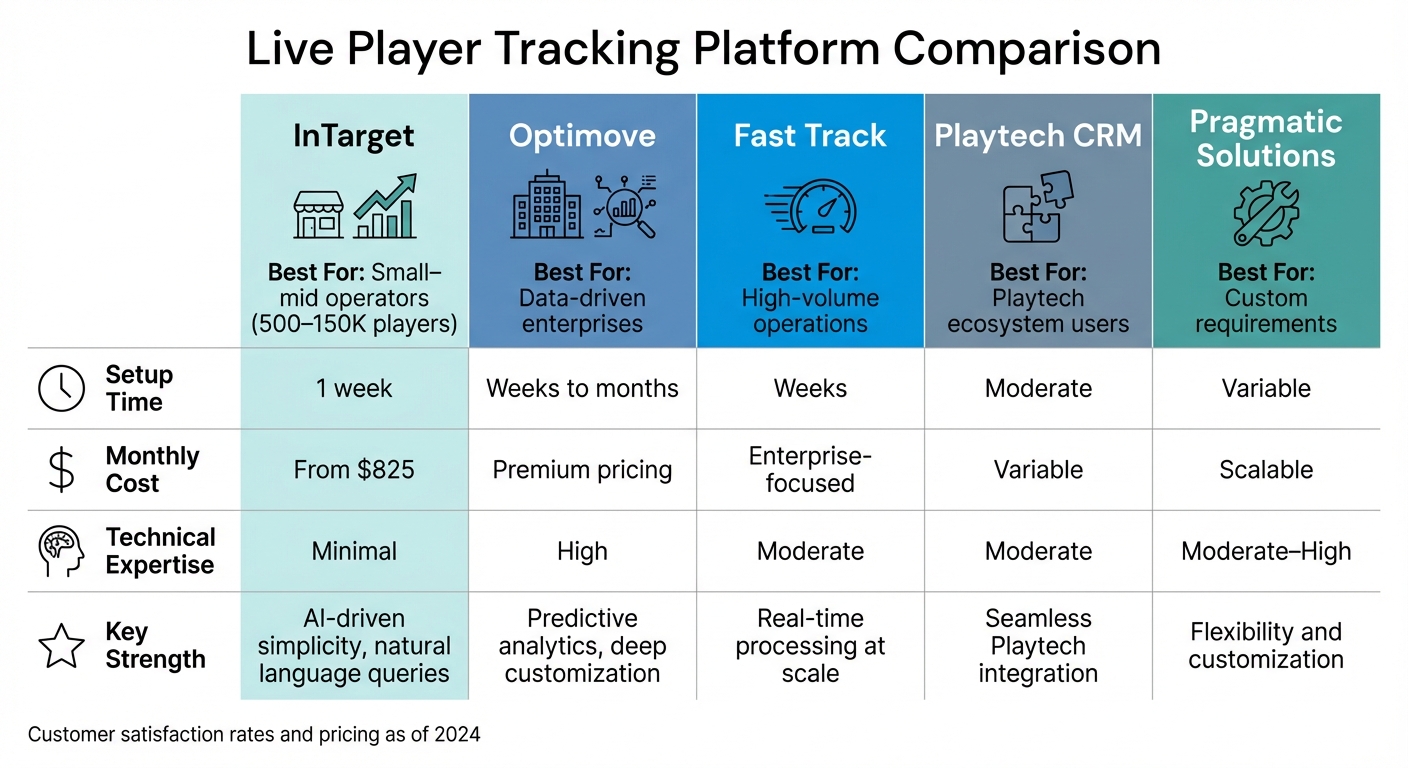
iGaming Live Player Tracking Platform Comparison: Features, Pricing & Setup Times
Choosing the right live player tracking platform depends on your operation’s size, budget, and technical capabilities. The iGaming CRM market generally falls into three categories: platforms designed for multi-brand operators with dedicated data teams, mid-tier solutions offering flexibility at a premium, and accessible options for small to mid-sized operators seeking advanced tools without unnecessary complexity.
Platform Comparison Table
| Platform | Best For | Setup Time | Monthly Cost | Technical Expertise | Key Strength |
|---|---|---|---|---|---|
| InTarget | Small–mid operators (500–150K players) | 1 week | From $825 | Minimal | AI-driven simplicity, natural language queries |
| Optimove | Data-driven enterprises | Weeks to months | Premium pricing | High | Predictive analytics, deep customization |
| Fast Track | High-volume operations | Weeks | Enterprise-focused | Moderate | Real-time processing at scale |
| Playtech CRM | Playtech ecosystem users | Moderate | Variable | Moderate | Seamless Playtech integration |
| Pragmatic Solutions | Custom requirements | Variable | Scalable | Moderate–High | Flexibility and customization |
This table outlines the key differences among leading platforms. Here’s a closer look at what makes these solutions stand out:
InTarget is tailored for operators managing 500 to 150,000 monthly players who need powerful yet straightforward tools. It offers over 50 real-time event triggers, enabling quick, data-driven decisions to engage players effectively. The platform also supports multi-wallet tracking for real money, bonuses, and cryptocurrency. One of its standout features is an AI assistant that answers questions in plain English – no need for SQL skills. For example, you can ask, "What were the top 10 games by player count last week?" and instantly get actionable insights.
"Best investment we made this year, hands down. The ROI tracking alone pays for itself. We finally know which campaigns drive deposits and which don’t." – Daniel V, Casino Manager
On the other hand, Optimove and Fast Track cater to larger operators with bigger budgets and dedicated technical teams. These platforms shine when it comes to advanced customization and scalability, but they come with longer onboarding times and higher costs. For operators who can commit to the investment, these tools provide deep analytics and powerful performance enhancements. However, they may be overkill for smaller operations.
Pricing and complexity are critical factors to consider. InTarget starts at $825 per month, offering transparent pricing that includes free data migration and a dedicated support manager. In comparison, generic CRMs often begin at $5,500 or more per month. Additionally, InTarget boasts a 97% customer satisfaction rate, according to client surveys, making it an appealing option for operators seeking a balance of affordability, ease of use, and robust features.
Best Practices and Common Pitfalls
To make the most of live player tracking, it’s essential to follow practices that prioritize data security, smart AI implementation, and manageable segmentation strategies.
Data Privacy and Compliance
Live player tracking generates a wealth of player data, but with great data comes great responsibility. For players in the EU, GDPR regulations apply, while CCPA covers California residents. Both require explicit consent for tracking real-time behavior. The key here is data minimization – only collect what’s necessary for your campaigns. For example, store deposits, game preferences, and session data securely using encrypted systems, and implement role-based access controls to ensure only authorized team members can access sensitive information.
Handling data responsibly isn’t just about compliance – it builds trust. And trust leads to better player retention. Automated tools for KYC (Know Your Customer) and AML (Anti-Money Laundering) can simplify compliance reporting across jurisdictions. Regularly audit your data practices, especially around fraud detection and bonus abuse prevention, to ensure you’re protecting player privacy while maintaining a secure system.
Once your data practices are solid, you can confidently use AI to transform raw data into actionable insights.
Using AI for Quick Insights
AI eliminates the time-consuming process of manual reporting, offering instant insights that speed up decision-making. With AI tools, you can adjust campaigns in real time based on factors like churn risk, engagement levels, or lifetime value (LTV) predictions.
Additionally, AI platforms can handle up to 80% of common player inquiries, freeing your team to focus on higher-priority retention efforts. Predictive algorithms are especially useful for identifying at-risk players early, enabling you to send targeted win-back offers before they disengage completely. That said, don’t rely too heavily on AI – there are always nuances in player behavior that require human judgment to address effectively.
Avoiding Over-Segmentation
While AI and compliance are essential, keeping your segmentation strategy simple is just as important. Over-segmentation can dilute statistical accuracy and make campaign management unnecessarily complicated. Instead, start with broad behavioral segments like engagement levels, churn risk, or player tiers. These categories are more likely to yield higher ROI because they’re grounded in meaningful patterns rather than arbitrary distinctions.
To ensure your segments are effective, validate them with A/B testing and prioritize based on value. For instance, high-LTV players might warrant personalized attention, while low-engagement groups could benefit from automated reactivation campaigns. Use AI thresholds to refine your strategy without overwhelming your team, and keep your approach straightforward enough to execute consistently across email, SMS, and push notifications.
Conclusion
Live player tracking gathers real-time data – like deposits, game preferences, session activity, and bonus usage – to power automated, tailored campaigns through email, SMS, and push notifications. The best platforms integrate smoothly with your existing systems, offer AI-driven insights without requiring a data science team, and include user-friendly dashboards to track metrics like LTV, ARPU, and churn. This makes real-time tracking a game-changer for staying competitive in the iGaming industry.
For small to mid-sized operators, the challenge isn’t just finding a CRM with live tracking – it’s finding one that’s easy to set up, budget-friendly, and doesn’t require a technical team to manage. That’s where InTarget comes in. It delivers enterprise-level retention tools without the usual headaches. With setup times as quick as one week and pricing starting at $825 per month, it offers a straightforward way to elevate player engagement.
The numbers back this up: operators using fully integrated live tracking see an average 28% boost in Player Lifetime Value. This growth comes from features like behavioral triggers, predictive churn algorithms, and multi-channel engagement that connects with players at just the right time.
If you’re running an online casino or sportsbook and haven’t adopted live player tracking yet, you could be leaving serious revenue on the table. Start by connecting your data sources, setting up behavioral triggers for key player milestones, and keeping a close eye on your dashboards. Adding real-time tracking to your CRM enables the proactive, data-driven strategies discussed throughout this guide. With targeted campaigns, automated triggers, and early churn detection, you’ll be well-positioned to thrive in the competitive iGaming market. Acting now could make all the difference in retention and profitability.
FAQs
How does live player tracking help retain players in online gambling?
Live player tracking delivers real-time insights into how players interact, allowing operators to react instantly with tailored offers, rewards, or even timely interventions. By spotting patterns like a drop in activity or a surge in engagement, operators can take immediate action to maintain player interest and loyalty.
For instance, if a player appears to be losing interest, a personalized bonus or promotion can be offered to draw them back in. Dynamic segmentation further refines this approach, enabling precise targeting so that every offer feels relevant and well-timed. These methods not only help retain players but also create a more enjoyable and engaging experience for them.
What features should I look for in a live player tracking solution for iGaming?
A solid live player tracking solution should offer instant insights into player behavior while being easy to set up and expand. Here are some standout features to consider:
- Real-time data capture: Track every action – whether it’s a click, bet, or deposit – as it happens, providing a clear picture of player activity.
- AI-powered insights: Spot trends, identify potential risks, and answer critical questions like, “Which players haven’t made a deposit in the past 10 days?”
- Effortless platform integration: Get up and running in days, not weeks, with minimal technical hurdles.
- Dynamic segmentation: Group players on the fly based on live metrics like session duration or spending patterns, allowing for tailored campaigns.
- Scalability for smaller operators: Enjoy transparent pricing and an intuitive interface that doesn’t demand a team of developers.
These capabilities empower operators to react swiftly to player actions, deliver customized experiences, and boost retention – all without the complexity of large-scale systems.
How long does it take to set up live player tracking in an iGaming CRM?
The time it takes to set up live player tracking in an iGaming CRM depends on the platform and the complexity of your system. For example, tools like InTarget are built for quick integration, often enabling operators to get started within just a few days. This efficient setup means you can begin monitoring player behavior and enhancing engagement without unnecessary delays.
If speed is a priority, opt for a CRM with pre-built integrations for popular iGaming platforms and a user-friendly interface. This way, your team can jump straight into delivering results without getting bogged down by technical hurdles.