
An important strategy considered during the creation of any business is the identification and segmentation of target audiences. They first identify and understand who they want to sell to and then model their products, services, and marketing to meet the target audiences’ preference.
Doing this ensures that the customers such businesses are interested in attracting will come for their products or services.
The same process can be used during the creation of an online casino. Keeping the target audience in mind during the development of online casinos is vital because it will directly impact the choice and selection of the content provided on the casinos. Additionally, targeting specific groups of people will also influence game providers’ choice, language options, payment systems, and the marketing plans and strategies that will be executed to attract customers to the casino.
Segmenting of casino audiences is also essential because it will help them target marketing content to the people that will respond to it, instead of targeting the entire audiences with generic messages. It will help them to optimize their marketing strategies. And in order to identify and segment the target audience of online casinos, it is vital first to understand online casino players to figure out the significant types and demography of players, their requirements, and motivations.
Online Casino Target Audience
This section shows some of the factors that should be considered to understand and identify the target audience for online casinos fully. After considering all of these factors, an online casino will properly understand players and find ways to retain them.
What Motivates People to Play?
All players are motivated by something that makes them want to play games on online casinos, and these motives can be classified into three general groups.
Playing to Win Money These are the type of players who visit online casinos to win money and can be found playing games regularly on the platforms. They are professional players that consider gambling in casinos as a vocation. They have their schedule, plans, and system of playing games to win money. The obvious way to attract such players and get them interested is to offer regular promotional bonuses and loyalty programs to active players.
Playing Due to Addiction Such players are motivated by compulsive gambling disorder. They visit casinos frequently, and unlike the professional gambler, they don’t have a plan or schedule for their gambling. They are addicted to gambling and find it difficult to stop. Even though gambling addicts can bring steady income, online casinos are advised to address the issue and take proper measures to restrict them. Such customers are at risk and will have a negative impact on the casino.
Playing for Fun These players only visit online casinos once in a while and play just to have fun. Due to the lack of experience, such players randomly select casinos and games without considering any significant factors that regular gamblers would bear in mind. These players can be easily attracted by offering fantastic welcome bonuses, rewards for registration, and having eye-catching designs.
Target Audience by the Game Type
The target audience can be divided into groups based on their preference in terms of game types, themes, and functionality.
- Card and table games: These include all non-slot games on online casinos like roulette, poker, baccarat, and blackjack. These are mostly for conservative gamers and fans of land-based casinos.
- Classic fruit slots: They are old school style slots with uncomplicated gameplay and simple features. Such slots are favourite for players who like traditional gambling halls.
- Modern Slots: These include all other slot games apart from the classic slots. They include five reels video slot games, 3D slots, and other customized versions with various themes, features, and elements. These games will suit players who value trends and innovations in gambling.
- Slots for women: Some slot games tend to be more popular among female players due to the appealing storylines and engaging characters.
Demographic Profile of the Target Audience
Demographic profiling has to do with grouping target audiences based on attributes like age, gender, income, and many more.
- Regardless of their income level, young individuals consider online casinos a source of amusement and a place to have fun.
- Middle-aged individuals with low income tend to visit online casinos to win and improve their financial condition.
- Middle-aged individuals with high incomes tend to visit casinos due to curiosity. They want to try their luck and skills on gaming sites.
InTarget CRM
Psychological Motivation of Gamblers
People are motivated and influenced by their feelings and emotions, and many psychological reasons influence different individuals to visit casinos to play games.
The common belief is that the most predominant motivation influencing different players is money, regardless of which group they belong to or what type of games they like to play. Apart from earning money, there are many more reasons why people choose to play casino games. Some players desire to experience risks, and some want to have fun, others want to showcase skills, etc.
How to Segment Your Target Audience Using CRM
Segmentation of target audiences is a necessary process that should not be neglected in businesses. Online casinos should ensure that they segment their target audience to custom-make each marketing strategy to reach the intended and potential customers they want to acquire or retain.
In a CRM, each of the groups described above becomes a saved set of conditions on player data. In the iGaming CRM from InTarget every player has one card with profile, transactions, casino game sessions, sports bets, bonuses, logins and the messages sent to them, and segments are built from that same data.
What Is Segmentation?
Segmentation is the practice of splitting your target audience into small groups of potential customers based on their similar needs and behaviours. Creating segments of your audience will help you to sell to different groups of people using specific strategies that are custom-made to meet their preferences.
To put it simply, the approach you will take when marketing to middle-aged individuals may not necessarily be the same approach that will be effective when marketing to young people. So, businesses need to segment their target audience to optimize their marketing strategies and resonate well with their potential customers.
An online casino that uses segmentation will have the desired results because tons of players visit such websites every day. They all have varied preferences and standards regarding casino games. Marketing the wrong games to the wrong audience is inefficient.
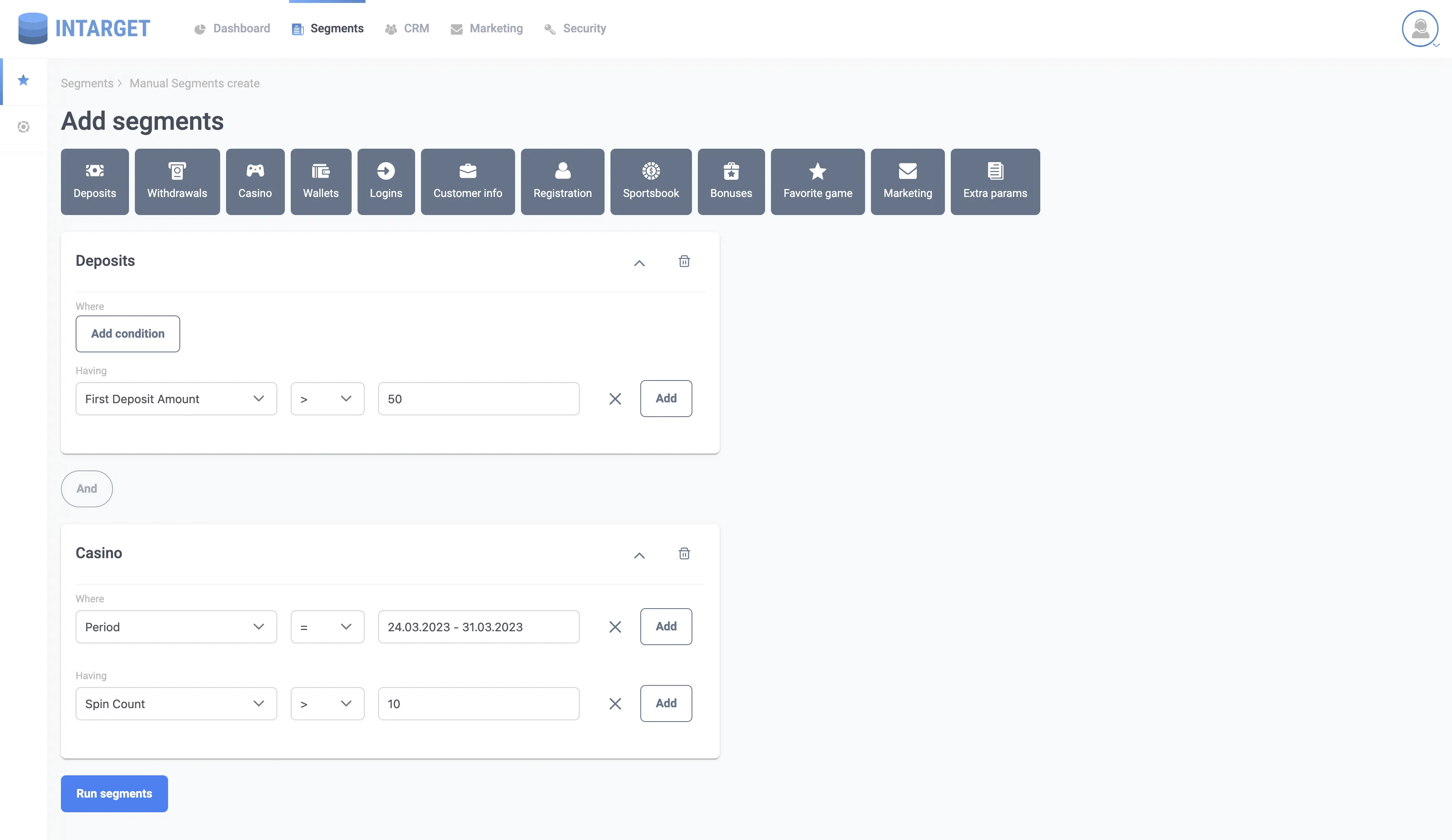 InTarget Segmentation
When Should You Use Audience Segmentation?
Even though you might get excited over the idea of segmenting your target audience, it is essential to know that not all businesses require segmentation. There are lots of reasons why businesses need to segment their target audience. The larger your business’s audience grows, the wider the opinions, predilections, and requirements you will need to cater to. And once this happens, your marketing strategies are at risk of being irrelevant to many of the people you are trying to reach.
You should segment your customers’ list:
- If your business offers varieties of products that serve different audiences;
- If your business offers varieties of products that serve different preferences and requirements of the same audience;
- If it offers a single product that serves many groups of audiences.
Many online casinos offer varieties of games with different game types, and they have a wide range of players who care about different things visiting their casino to play them. So, target audience segmentation is a good practice that can help them effectively optimize their marketing strategies to reach their intended audiences fully.
What Should You Segment Audiences Base On?
Once you have identified your target audience and discover that you have broad groups of customers to cater to, you need to segment them into groups based on their common characteristics. There are many factors that businesses can use to segment their audience, and they can pretty much decide on any factor to use.
The major factors considered during audience segmentation are:
- Demography – considers age, sex, occupation, income, nationality, and more.
- Behaviour – considers usage rate, habits, lifestyle, loyalty, etc.
- Psychographic – considers audiences’ personality traits, interests, values, opinions, etc.
- Geographic – considers the motives, needs, and predilection of the audiences in different locations.
There are many more factors that you can consider based on the ones that will effectively work for you.
In InTarget, a CRM, marketing automation and analytics platform for iGaming operators, these factors become conditions in the segment builder. Not every factor exists as data. Age, gender, country, language and behaviour do. Occupation, income and psychographic traits do not, unless your platform sends them as extra player parameters. The steps are:
- Segment your players. Pick conditions from the library (about 190, in groups such as Customer info, Transactions, Casino, Sportsbook and Logins), give each an operator, a value and a period, and choose whether a player must meet all conditions or at least one. For the audiences in this article: Country, Language and Customer Age for demography and geography; Favorite Game and Casino Game Total Bet Amount by game type (Slots, Table Game, Live Casino) for slots players versus card and table players; Deposits Count and Total Deposits Amount for regular players versus occasional ones. Preview the size and the member list before you use the segment.
- Prepare your messaging. Create a template for each channel (email, SMS, push, on-site message), add translations so that each player receives the version in their profile language, and use variables such as first name or favorite casino game.
- Engage your segments. Start an automated campaign from the segment, or from an event such as Registration or Deposit. For each step the statistics show how many messages were delivered, opened and clicked, and how many deposits followed.
Players flagged as blocked or self-excluded in the operator’s data are skipped by every send, which matters for the at-risk players described earlier.
Conclusion
Identify who your players are and why they play, then turn each group into a segment with its own message. Marketing a new 3D slot to classic slots players, or new video slots to players who prefer card and table games, will not bring the desired results. Start with two or three segments that differ by game type and by how often players deposit, and add another only when you have a different message for it.